Loja Coffee Renaissance: History & Altitude
Quick Summary: Southern Ecuador has a rich agricultural legacy that produced coffee for generations before global markets shifted attention elsewhere. Today, high-altitude farms across Loja are spearheading a specialty renaissance driven by heirloom varieties, precision wet milling, and exporter-direct traceability.
In the global specialty coffee landscape, certain origins carry decades of continuous branding, while others represent newly emerging frontiers. Southern Ecuador belongs to a unique third category: a historical origin whose extraordinary geographic potential was overlooked for decades, now experiencing an unprecedented quality renaissance.
As an exporter rooted in Loja, Cafesure works inside this evolving landscape every day. This article explores the historical arc of coffee in southern Ecuador, the structural reasons behind its temporary decline, and how high-altitude terroir and heirloom genetics are positioning the region as one of specialty coffee’s most compelling origins. For a complete regional overview, see our guide to the Loja coffee region.
The Early Days of Coffee in Southern Ecuador
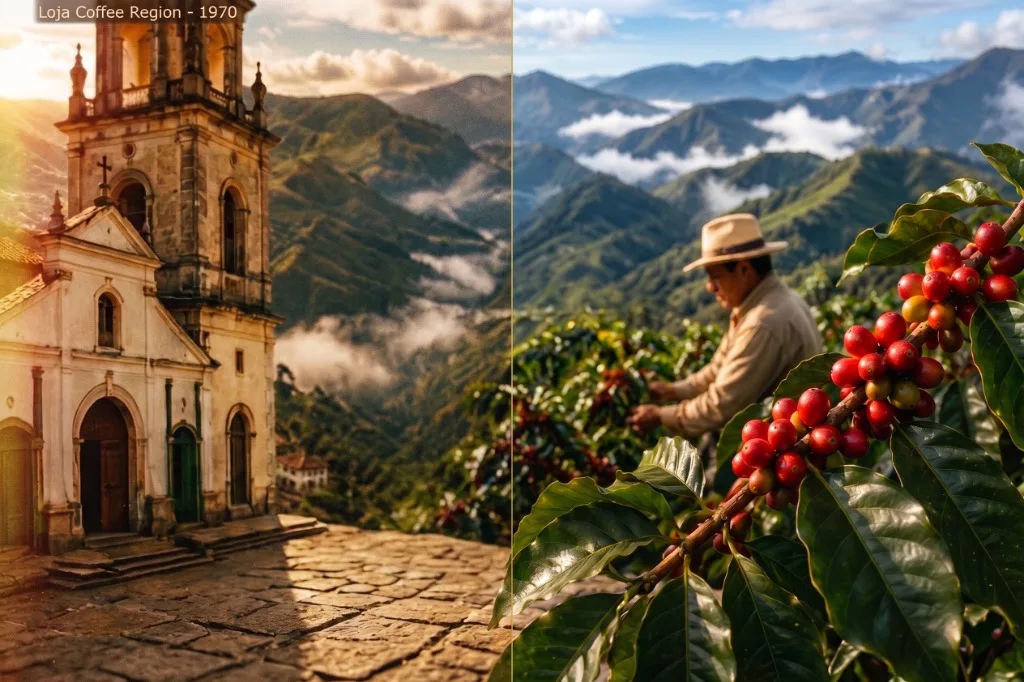
Coffee cultivation in southern Ecuador dates back to the 19th century, when Typica varieties introduced to the Andean valleys adapted to local soil and elevation profiles.
During the early to mid-20th century, farms across southern Ecuador established shade-grown agroforestry systems. The region’s unique geographical positioning—where mountain ranges intersect Pacific coastal breezes and Amazonian moisture—created microclimates ideal for slow cherry maturation.
Key Historical Characteristics
- Original Varieties: Dominated by traditional Typica selections that adapted over generations to elevations above 1,600 meters.
- Processing Methods: Traditional fully washed processing using mountain river water, dried under natural sunlight.
- Domestic & Regional Recognition: Revered domestically for clean sweetness and floral aromatics, though direct international export channels remained minimal.
The Structural Shift: Why the Origin Faded from Global Catalogs
Despite favorable growing conditions, southern Ecuador’s coffee sector experienced a prolonged period of reduced international visibility during the late 20th century. This shift was driven by structural factors rather than agronomic limitations:
- Supply Chain Fragmentation: Coffee was predominantly traded as commercial cherry through layers of local collectors (intermediarios), bulking lots together and erasing farm-level identity.
- Infrastructure Deficits: Smallholder producers lacked access to micro-lot wet milling equipment, moisture meters, and raised drying beds required for specialty standards.
- Rise of Mass Commodities: Global coffee markets prioritized high-volume commodity origins, placing small-scale Andean producers at a commercial disadvantage.
As a result, while neighboring Andean origins built massive export brands, southern Ecuador’s high-altitude lots were frequently blended into generic commercial exports or sold into local markets.
The High-Altitude Renaissance
The turn of the 21st century marked a turning point. Driven by a global shift toward micro-lot traceability and single-origin transparency, coffee professionals began rediscovering the untapped quality of southern Ecuador’s mountain farms.
| Era | Phase | Industry Context | Sourcing Model |
|---|---|---|---|
| 19th Century | Early Cultivation | Traditional Typica introduction | Local domestic trade |
| Mid-20th Century | Agroforestry Era | Shade systems established | Regional market supply |
| Late 20th Century | Structural Shift | Intermediary consolidation | Generic bulk exports |
| Modern Era (2020s+) | High-Altitude Revival | Specialty renaissance | Exporter-direct micro-lots |
Drivers of the Modern Revival
- Altitude Advantage: Modern cuppers recognized that farms operating between 1,700 and 2,150 meters were producing beans with exceptional density and bright citric acidity.
- On-Farm Quality Management: Investment in parabolic solar dryers, Brix refractometers, and controlled fermentation tanks transformed farm-level processing.
- Direct Traceability: Exporter-direct partnerships enabled producers to separate lots by variety, block, and harvest pass, delivering fully documented micro-lots to international roasters.
For insight into how direct supply chains operate in practice, read our guide on direct trade coffee explained.
Heirlooms as Heritage: Typica Mejorado and Sidra
Central to southern Ecuador’s coffee renaissance is its distinct genetic heritage. While many global regions replaced traditional trees with high-yielding hybrids, producers in Loja preserved unique heirloom selections.
Typica Mejorado
Widely recognized as a signature variety of southern Ecuador, Typica Mejorado was refined across high-altitude farms. It delivers an extraordinary cup profile featuring intense jasmine aromatics, vibrant citric acidity, and complex stone fruit notes. Read more in our deep dive on Typica Mejorado specialty coffee.
Sidra
A Bourbon × Typica selection that thrives in Andean mountain soils. Sidra lots combine rich brown sugar sweetness, creamy mouthfeel, and delicate floral highlights. Discover details in our Sidra coffee guide.
What Loja Represents for International Buyers Today
For specialty roasters and importers, southern Ecuador represents a rare combination: historical terroir paired with modern specialty execution.
Why the Origin Stands Out
- Uncompromised Quality Potential: High altitude and cool night temperatures yield dense beans that excel on both filter and espresso menus.
- Menu Differentiation: Offering a single-origin Typica Mejorado or Sidra from Loja provides roasters with a distinct story that sets them apart from conventional origin lineups.
- Full Traceability: Working with origin-based exporters ensures every container is backed by lot-level farm data, harvest dates, and processing metrics.
To learn more about evaluating and securing lots from current harvests, explore our Ecuador coffee sourcing calendar or contact our team to sample current offerings.