How to Import Coffee from Ecuador: 2026 Guide
Quick Summary: How to import coffee from Ecuador: FDA Prior Notice, supplier registration, HS codes 0901.21, shipping logistics, Incoterms, and lead times.
Ecuador has become a serious origin for specialty green Arabica, and increasingly, microroasters, importers, and green buyers in the US, Canada, the Middle East, and Asia want to import coffee from Ecuador directly from origin rather than through a US-based intermediary. This guide walks through the full process: from sample evaluation through FDA and US Customs requirements, HS code classification, Incoterms, air and ocean shipping logistics, and the common pitfalls that delay first-time importers.
Ecuador’s case is genuinely different from more established origins like Colombia or Brazil. Volumes are smaller, lot traceability is higher, and varietals like Typica Mejorado, Sidra, and Gesha from Loja and Zamora-Chinchipe command premium prices for a reason. The mechanics of getting that coffee out of Ecuador and into your warehouse, however, are still the mechanics of international food trade. Get them right and the relationship scales; get them wrong and your first container sits in a bond room for three weeks.
Why Import Directly From an Ecuadorian Exporter
Most US buyers are used to buying through an importer who already holds the green in a domestic warehouse. Buying direct from an exporter like Cafesure changes three things: price (no importer markup), access (you see lots before they are committed to importer pipelines), and traceability (you deal with the people who physically bought the coffee from the producer). The trade-off is that you handle (or your customs broker handles) the import mechanics yourself.
For a microroaster buying 50 to 500 kg of a Typica Mejorado micro-lot for a seasonal offering, the direct route is usually the only way to get the lot at all. For an established importer or roastery buying a half-container or full container, direct trade economics can be meaningfully better than going through a US intermediary.
The practical sourcing economics of importing direct:
-
CapEx savings: You don’t need to travel to origin, build a cupping lab in Ecuador, or hire an export team. Your origin partner acts as your on-the-ground sourcing arm.
-
Margin expansion: You access farm-gate proximity pricing. Even with air freight factored in, the landed cost of high-end varieties like Typica Mejorado or Gesha is highly competitive compared to spot offerings from domestic importers.
-
Supply security: You secure your volumes early in the harvest, preventing stockouts of your core menu offerings.
Step 1: Evaluate Samples Before Committing
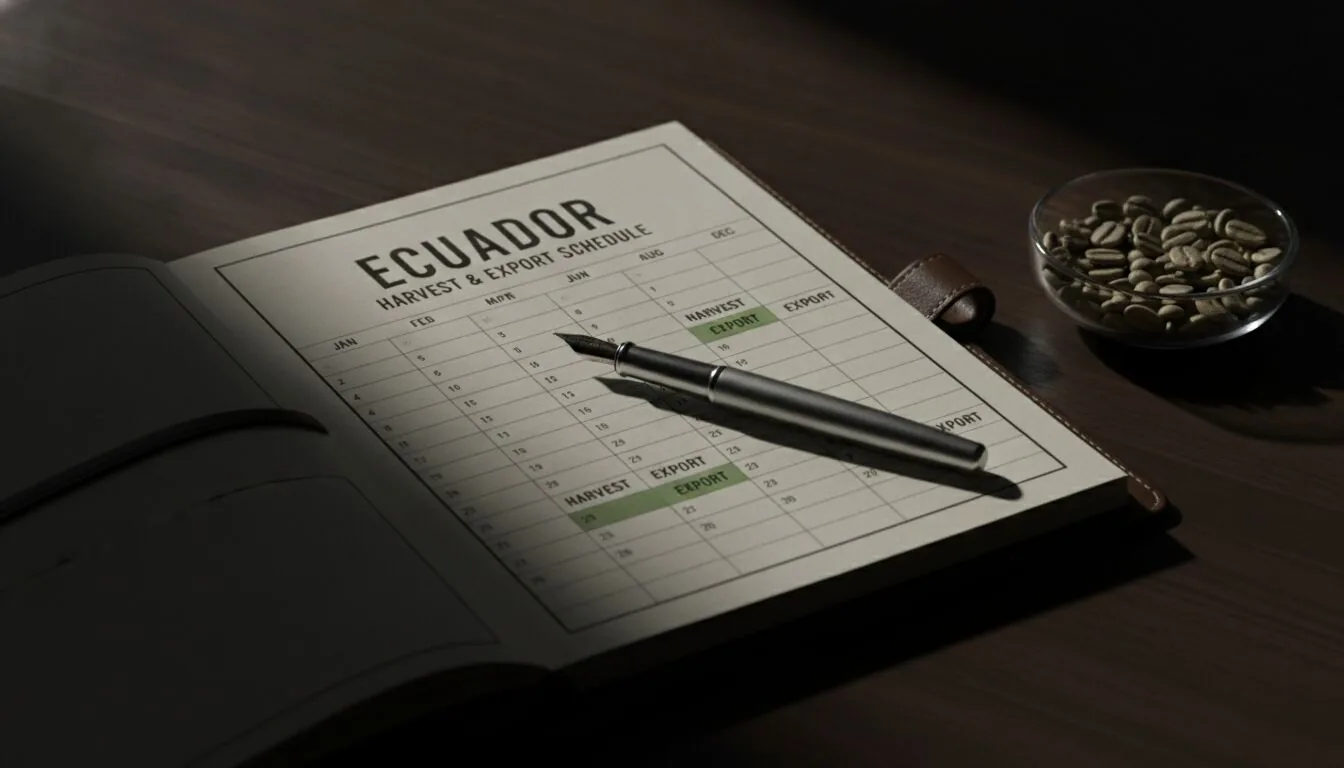
Before any commercial conversation about importing, evaluate a green coffee sample lot. This is non-negotiable. Request 300 to 350 g samples of each lot you are seriously considering, roast small probe batches, and cup them blind against lots you already know. See our sourcing calendar to coordinate sample arrivals with the harvest cycle.
Things to confirm in writing with the exporter before you commit to a purchase order:
-
Lot size available (in 46 kg or 69 kg bags, or vacuum bricks)
-
Cupping score (SCA protocol, 84+ is specialty, 86+ is solid specialty, 88+ is exceptional)
-
Variety, altitude, process (washed, honey, natural), and farm/producer name
-
FOB or CIF price in USD per pound or per kilogram
-
Harvest date and “current crop” confirmation
-
Whether the lot is contracted or still available
Step 2: Understand US FDA and Customs Requirements
If you are importing into the United States, the FDA and US Customs and Border Protection (CBP) both have jurisdiction. The core requirements for green coffee:
-
Foreign Supplier Verification: The Ecuadorian exporter must hold a valid FDA Food Facility Registration. Request the registration number and confirm it is current.
-
Prior Notice: The importer (or their broker) must file Prior Notice with FDA before the shipment arrives at the US port. This is done through FDA’s Prior Notice System Interface, typically integrated into the broker’s ABI filing.
-
Phytosanitary certificates: Ecuador’s Ministry of Agriculture (AGROCALIDAD) issues the mandatory health certificates for green coffee exports. A reliable exporter coordinates these before the coffee leaves origin, so your broker has a complete document packet on arrival.
For European buyers, the regulatory landscape has shifted significantly with the EU Deforestation Regulation (EUDR). Every shipment entering the EU now requires geolocation data and satellite-verified deforestation-free documentation. See our EUDR compliance guide for a full walkthrough of the requirements and how our due diligence system works.
-
FDA Holding: Green coffee is an FDA-regulated food. FDA may examine samples at the port; defective or contaminated lots can be refused entry.
-
Importer of Record: You need a US entity with an IRS number (EIN) to act as the importer of record on customs entries.
-
CBP Entry: Filed via your customs broker using the appropriate Harmonized Tariff Schedule (HTS) code.
Step 3: Get the HS Code Right
Green coffee is classified under HS heading 0901. The two subheadings that matter for specialty green buyers:
-
0901.21: Coffee, roasted or not, in primary form: not decaffeinated. This is the code for nearly all specialty green Arabica.
-
0901.22: Coffee, roasted or not, in primary form: decaffeinated.
For US entries, the full HTS code (10 digits) determines the duty rate. Most green Arabica from Ecuador enters the US duty-free under the US-Ecuador trade preferences, but you must classify correctly and your broker must verify the rate at time of entry. Roasted coffee, soluble coffee, and coffee extracts each have different HTS codes, do not assume 0901.21 covers everything.
Step 4: Choose Shipping Mode (Air vs. Ocean) and Incoterms
Specialty green coffee from Ecuador requires careful logistics to preserve its quality. Because Cafesure specializes in high-value, high-altitude micro-lots, our shipping model is structured to prioritize quality retention and transit speed.
Air Freight (Primary Shipping Mode)
For the vast majority of our specialty micro-lots (especially delicate varieties like Typica Mejorado, Sidra, and Gesha), air freight is our primary and recommended shipping mode.
Cargo departs from either Quito International Airport (UIO) or Guayaquil International Airport (GYE).
-
Why Air Freight? High-altitude green coffee is highly sensitive to temperature and humidity fluctuations. Ocean freight exposes coffee to weeks in hot cargo containers crossing the equator. Air freight gets the coffee from our climate-controlled dry mill in Loja to your roastery in 3 to 5 business days, preserving the volatile floral and fruit aromatics of these delicate varieties.
-
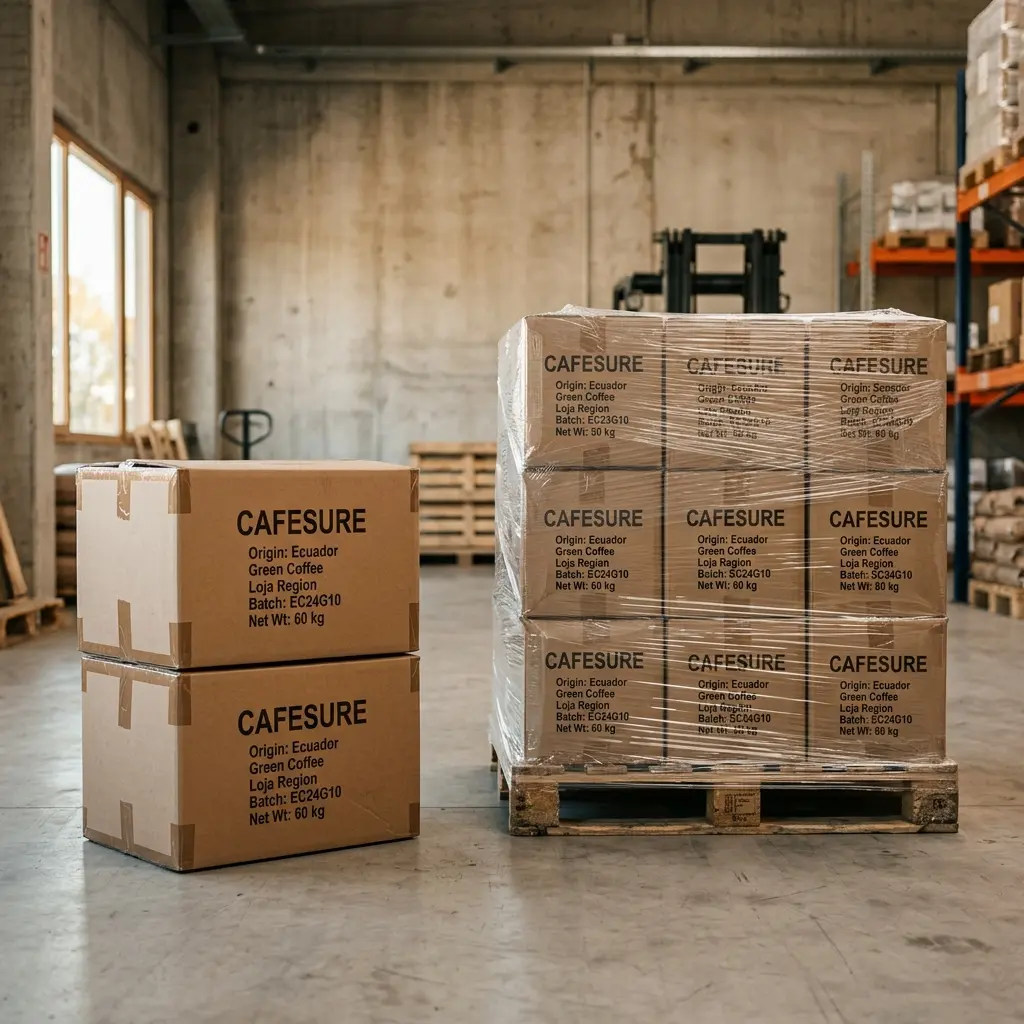
MOQs for Air Cargo: We regularly ship air freight orders starting from a single bag (46 kg or 69 kg) up to multi-pallet shipments (500 kg to 2,000 kg).
Air Freight Incoterms:
-
FCA (Free Carrier, Quito UIO or Guayaquil GYE): Cafesure handles export clearance in Ecuador and delivers the coffee to the airline cargo terminal in Quito or Guayaquil. The buyer pays for and manages the international air transit and destination costs.
-
CIP (Carriage and Insurance Paid to destination airport): Cafesure arranges and pays for the air freight and cargo insurance to your nearest international airport. The buyer is responsible for customs clearance and local delivery from the airport.
Ocean Freight (Secondary Shipping Mode)
For larger volumes, regional consolidation, or large contracted lots (typically 2,000 kg or more), we support ocean freight. All maritime cargo leaves through the Port of Guayaquil (Puerto Marítimo de Guayaquil), Ecuador’s main export terminal.
Ocean Freight Incoterms:
-
FOB (Free On Board, Port of Guayaquil): Cafesure handles inland transport, customs export documents, and loads the coffee bags (consolidated as LCL or FCL) onto the vessel in Guayaquil. The buyer is responsible for ocean freight, maritime insurance, and destination fees.
-
CIF (Cost, Insurance, and Freight): Cafesure pays for ocean transport and insurance to your destination port (e.g., Port of Miami, Hamburg, Antwerp). The buyer handles customs clearance at the port.
-
EXW (Ex Works) and DAP (Delivered at Place) are available under specific negotiations, though FCA (for air) and FOB (for ocean) remain the cleanest commercial standards.
Step 5: Work With a Customs Broker
You need a licensed US customs broker to clear the shipment through CBP and FDA. If you do not have one, freight forwarders typically offer brokerage in-house or can refer you. The broker will need from you:
-
FDA Prior Notice confirmation number
-
Exporter’s FDA Food Facility Registration number
-
Commercial invoice (with HS code, value, currency, country of origin)
-
Packing list (weights, bag count, marks)
-
Bill of lading or air waybill
-
Certificate of origin (if claiming preferential duty treatment)
Engage the broker before the shipment sails, not after. Errors discovered on arrival are expensive.
Step 6: MOQ and Lead Times
For specialty direct trade, MOQs vary by exporter. At Cafesure, we work with buyers from a single bag (46 kg) of a specific micro-lot up to full containers. The realistic economics:
-
Single bag or vacuum lot (15 to 69 kg), feasible for evaluation or a small seasonal release
-
A few bags (100 to 300 kg), typical for microroaster seasonal offerings
-
Pallet quantities (500 kg to 1,000 kg), standard for established roastery programs
-
Half or full container (5 to 19 tonnes), for importers and mid-size roasters
For buyers not yet ready for pallet quantities, we offer flexible micro-lot volumes starting at 40 kg. See our PYMES coffee sourcing guide for the scaled-down MOQ options and how they work.
Typical lead time from purchase order to delivered warehouse, assuming the lot is ready and on hand, depends on the shipping mode:
-
Air Freight (3 to 5 weeks total):
-
Sample approval & contract: 1 to 2 weeks
-
Preparation & export clearance: 1 week
-
Air freight transit (UIO/GYE to major hubs): 3 to 5 business days
-
Customs clearance & local courier delivery: 3 to 5 business days
-
Ocean Freight (6 to 10 weeks total):
-
Sample approval & contract: 1 to 2 weeks
-
Port documentation & vessel consolidation: 1 to 2 weeks
-
Ocean transit (Guayaquil to US port): 14 to 25 days (East Coast), 18 to 30 days (West Coast via Panama Canal)
-
Customs clearance: 3 to 7 days
-
Inland delivery: 2 to 7 days
Pre-harvest or contracted micro-lots (coffee still being harvested, fermented, or dried in Loja) will add 4 to 12 weeks of agricultural processing time on top of these transit windows.
Step 7: Payment Terms
Specialty coffee exporters in Ecuador typically work in USD (Ecuador uses the US dollar). Standard payment terms for first-time buyers:
-
30 to 50% deposit on contract, balance before shipment (most common for new relationships)
-
100% advance for small sample-into-first-order transactions
-
Letter of credit for high-volume contracts
-
Net 15 or Net 30: rare for new buyers; reserved for established accounts after multiple successful shipments
Wire transfer (SWIFT) is the standard mechanism. Confirm beneficiary bank details in writing, by phone, and on a signed proforma invoice, wire fraud targeting international trade is real.
Common Pitfalls to Avoid
A few mistakes that routinely cost first-time Ecuador importers time and money:
-
Not filing Prior Notice: CBP will hold the shipment and may refuse entry. Your broker should handle this; confirm they have.
-
Wrong HS code on the commercial invoice: leads to delays and possible penalties. Work with the exporter to get the exact 10-digit HTS code right before shipping.
-
No FDA facility registration for the exporter: if the exporter is not registered, your shipment cannot legally enter the US. Confirm the registration number before contracting.
-
Underestimating lead times: first-time buyers often assume coffee ships the day they wire funds. It does not. Plan for 3 to 5 weeks for air freight, or 6 to 10 weeks for ocean freight.
-
Using maritime Incoterms for air cargo: using FOB or CIF for air freight is technically incorrect and causes confusion on air waybills and commercial invoices. Use FCA or CIP for air cargo.
-
Choosing the cheapest freight forwarder: in coffee, freight handling matters. A forwarder who lets your vacuum-sealed bricks sit in a hot container or airport warehouse for a week will ruin the lot.
-
No written quality agreement: spell out defect tolerances, moisture ranges, and cupping score expectations in the contract. Disputes without a written spec are unwinnable.
-
Ignoring harvest timing: Ecuador’s main harvest in Loja runs May through September. Buying “fresh crop” Typica Mejorado in February means you are buying last year’s crop or contracted coffee for the next harvest. Neither is wrong; just know which one.
Ready to Import Coffee From Ecuador?
If you are evaluating Ecuador as a sourcing origin, the fastest path is to start with samples. We ship 300 to 350 g samples of available Typica Mejorado, Sidra, and Gesha lots from Loja along with full lot data, variety, altitude, process, score, farm, and FOB price. Message us through our contact form to request samples, or read more about our direct trade model and how we handle traceability from origin.
The mechanics of importing take some setup, but once your FDA Prior Notice workflow and customs broker relationship are in place, repeat orders move predictably. We help buyers through the first import end-to-end so the second one is routine.
New to Cafesure? Start with our welcome overview for a guided tour of our sourcing model, variety lineup, and logistics coverage.