Tech Differentiators in Ecuador Coffee
Quick Summary: How Cafesure uses sat-coffee satellite monitoring, OriginFlow traceability, and GIS polygon mapping to give buyers verifiable, farm-to-port data on Ecuadorian specialty coffee, delivered via QR labels.
Specialty coffee buyers used to accept origin stories at face value. They no longer have to. The cost of geolocation hardware, satellite imagery, and structured data infrastructure has fallen far enough that verifiable, farm-to-port traceability is now a baseline expectation, not a premium feature.
For an exporter like Cafesure, operating in the small-holder landscape of southern Loja, technology is not a marketing layer. It is the only practical way to consolidate hundreds of micro-producers into lots that a North American, Middle Eastern, or Asian roaster can contract with confidence. This guide outlines our sat-coffee + OriginFlow stack and what buyers actually receive when they source a Cafesure lot, QR traceability labels with complete lot data. These same systems underpin our EUDR compliance framework, where satellite forest-cover verification and farm-level polygon mapping are mandatory, not optional.
1. The Three Layers of Cafesure’s Technology Stack
Our sourcing infrastructure is organized into three functional layers, each addressing a different question buyers ask.
Cafesure Sourcing Technology Stack: Capture Layer (Farm Data) → Verification Layer (sat-coffee Pilot) → Delivery Layer (OriginFlow → QR)
Layer 1: Capture
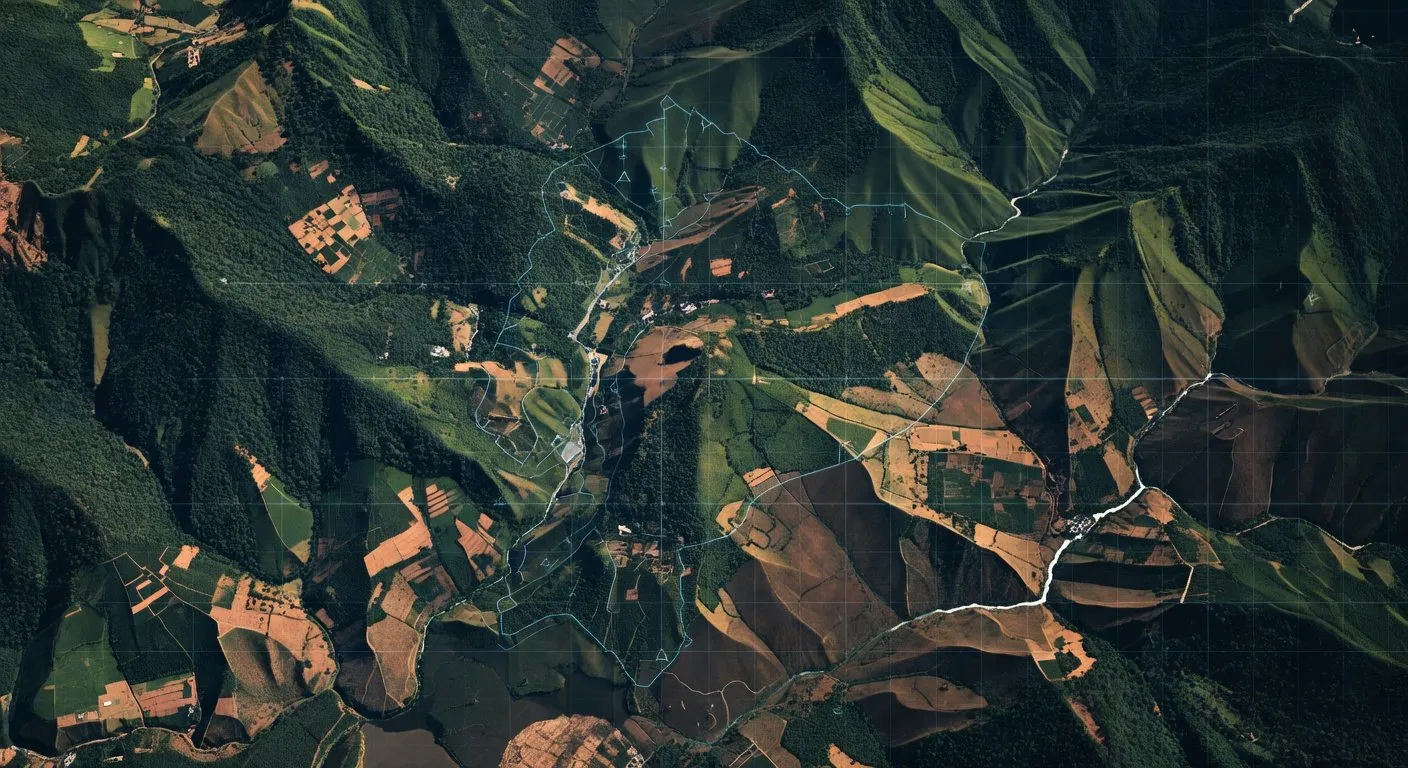
At the farm level we collect agronomic and geographic data: variety, altitude, harvest date, processing method, and the geolocation of each plot. For farms under 4 hectares we record a single GPS point; for farms 4 hectares and larger we walk the perimeter to record a full GIS polygon.
Layer 2: Verification, sat-coffee Pilot
sat-coffee is our satellite monitoring pilot currently running with a select group of producers in southern Ecuador. It cross-references each geolocated farm against time-series satellite imagery (Sentinel-2 and Landsat) to monitor land-use change over time. The pilot is designed to prove the model at origin before scaling across the full producer network.
Layer 3: Delivery, OriginFlow → QR Label
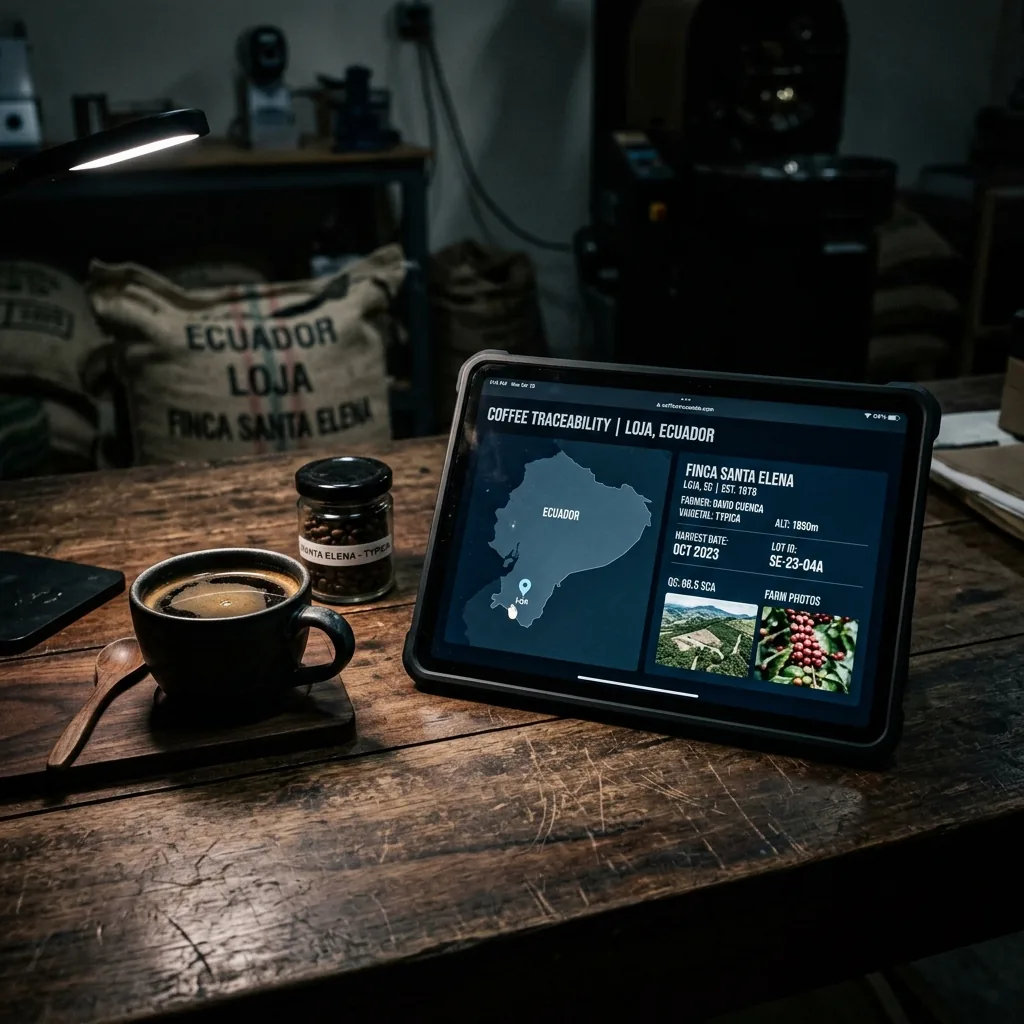
OriginFlow is our internal traceability platform. It takes the farm-level capture data and sat-coffee verification, links them to the commercial chain of custody, wet mill, dry mill, export registry, port of departure, and produces the buyer-facing output: a QR traceability label attached to every exported lot. One scan gives the buyer the complete lot profile.
2. Geolocation & Polygon Mapping at the Farm Level
The foundation of any credible traceability claim is accurate farm geography. Cafesure maps its entire producer network in southern Ecuador using geographic information systems (GIS):
-
Farms under 4 Hectares: We collect a single GPS point coordinate (latitude and longitude) taken at the center of the coffee cultivation area.
-
Farms 4 Hectares and Larger: We perform boundary walks to record full GIS polygons, ensuring the exact perimeter of the coffee fields is mapped.
Farm < 4 ha → Single GPS Point (Lat/Long Center) Farm >= 4 ha → Full GIS Polygon Boundary Map
This is the same geolocation standard expected by major specialty buyers, but we apply it to every farm in our network regardless of destination market. A buyer in the United States, the United Kingdom, Japan, or the Middle East receives the same GIS dataset.
3. Satellite Verification, The sat-coffee Pilot
Geolocation alone proves where a farm is. It does not prove what happened to the land before coffee was planted. That is the role of our sat-coffee pilot program.
sat-coffee is currently running as a pilot with a select group of producers in the Loja network. The program ingests publicly available satellite imagery from the European Space Agency’s Sentinel-2 program and the US Geological Survey’s Landsat archive, both of which provide free, regularly updated coverage of the Ecuadorian Andes. For each geolocated farm in the pilot group, sat-coffee:
-
Establishes a baseline by pulling historical imagery back to the start of each producer partnership.
-
Detects land-use change by comparing current imagery against that baseline using vegetation indices (NDVI) and cloud-resistant compositing.
-
Flags anomalies for human review, allowing our agronomy team to investigate before the lot is approved for export.
The pilot is designed to validate the monitoring workflow, refine detection accuracy, and demonstrate the model’s value before scaling to the full producer network. The result is independent, third-party-sourced evidence that a given lot was not produced on recently deforested land, evidence that flows through OriginFlow into the QR traceability label shipped with every lot.
4. QR Traceability Labels: From Origin to One Scan
The biggest gap in specialty coffee traceability is not data collection, it is data delivery. Most exporters can tell you which farm a lot came from, but the data sits in a spreadsheet or PDF that nobody opens.
We close that gap with a QR traceability label on every exported lot. Internally, sat-coffee feeds verification data into OriginFlow, which processes it alongside farm capture data and chain-of-custody records. The output is a QR label, the only thing the buyer sees:
sat-coffee (satellite) → OriginFlow (internal) → QR Label (client) When a buyer scans the QR label on a Cafesure lot, they see:
-
Farm & Producer: Name, GPS coordinates or GIS polygon, altitude
-
Variety & Process: Typica Mejorado, Sidra, Gesha, Caturra, Bourbon, washed, honey, or natural
-
Harvest & Milling: Harvest date, wet mill and dry mill records, intake weights
-
Satellite Verification: sat-coffee land-use-change check result for each contributing farm
-
Export Documentation: SAE certificate, phytosanitary permit, container and bag numbers
-
Chain of Custody: Full trail from Loja farmgate to Port of Guayaquil
This is not a PDF traceability report buried in an email attachment. It is a scan-and-view digital record, consumer-facing, buyer-ready, and machine-readable.
5. What Buyers Actually Receive
If you are importing Cafesure specialty micro-lots (such as Typica Mejorado or Sidra) into any market, our export package contains:
-
QR Traceability Label: Unique QR code per lot, scannable from the bag, farm data, satellite verification, milling records, export docs, chain of custody.
-
Geographic Coordinate File (JSON/CSV): Clean GIS points or polygons for all farms contributing to the lot.
-
Satellite Verification Report: sat-coffee land-use-change check against the producer-partnership baseline (pilot lots).
-
Ecuadorian Export Registry: SAE certificates and phytosanitary permits.
-
B.I.C. Impact Report: Independent compliance audit confirming fair wages and legal labor. Read more about our B.I.C. sustainability framework.
To coordinate your shipment and receive the full data package, contact our team via contact form.