Shade-Grown Coffee: Loja's Slow Ripening
Quick Summary: Shade does more than protect a coffee plant from direct sun. In Loja, agroforestry systems can reduce daytime temperature and wind while increasing relative humidity and moderating daily environmental fluctuations. Those changes can influence cherry development and crop physiology, but shade should not be treated as a guaranteed recipe for sweeter coffee. The quality effect depends on canopy density, altitude, variety, water availability and farm management.
The phrase shade-grown coffee is one of specialty coffee’s most attractive sustainability claims.
It is also one of the easiest to oversimplify. Shade does not automatically make coffee better.
What it does is change the environment in which the coffee plant grows.
And in Loja, that environmental change is measurable. Research conducted across three coffee-producing areas of Loja found that agroforestry systems altered temperature, relative humidity and wind compared with exposed full-sun conditions. The study recorded temperature differences ranging from approximately −4.23°C to +2.23°C and relative-humidity differences of up to 10.54 percentage points, depending on the site and conditions.
That means shade is not simply a visual characteristic of a coffee farm.
It is a microclimate management tool. And because microclimate influences how a coffee plant develops, shade can become part of the terroir story.
Shade and Slow Ripening
The most common explanation for shade-grown coffee is simple:
Shade slows the cherry.
There is truth in that idea, but the mechanism deserves more precision.
Trees above the coffee canopy reduce incoming solar radiation and moderate temperature. They can also reduce wind speed and change humidity around the coffee plants. Research in Loja confirms that shade systems create a more moderated microclimate, with lower daytime temperatures and lower wind speeds, while maintaining higher relative humidity than exposed conditions.
That changes the physiological environment of the coffee plant. In principle, a moderated thermal regime can influence the pace of cherry development and the balance between photosynthesis, respiration and water use.
But it is important not to turn this into another oversimplified specialty-coffee formula:
more shade ≠ more sweetness. Excessive shade can reduce available light for photosynthesis, alter productivity and increase humidity to levels that may create agronomic problems. The Loja study specifically notes that poorly managed shade can push relative humidity above levels favorable for disease development.
The relevant question is therefore not: “Is this coffee shaded?” It is:
“What kind of shade system is this, and what microclimate does it create?”
Shade is a Climate Intervention
A coffee agroforestry system effectively creates another layer between the atmosphere and the coffee plant.
The canopy intercepts solar radiation. It slows the wind. It modifies evapotranspiration. It changes humidity. It influences the temperature around the coffee leaves and cherries.
And, importantly, these effects can vary depending on the composition and density of the canopy.
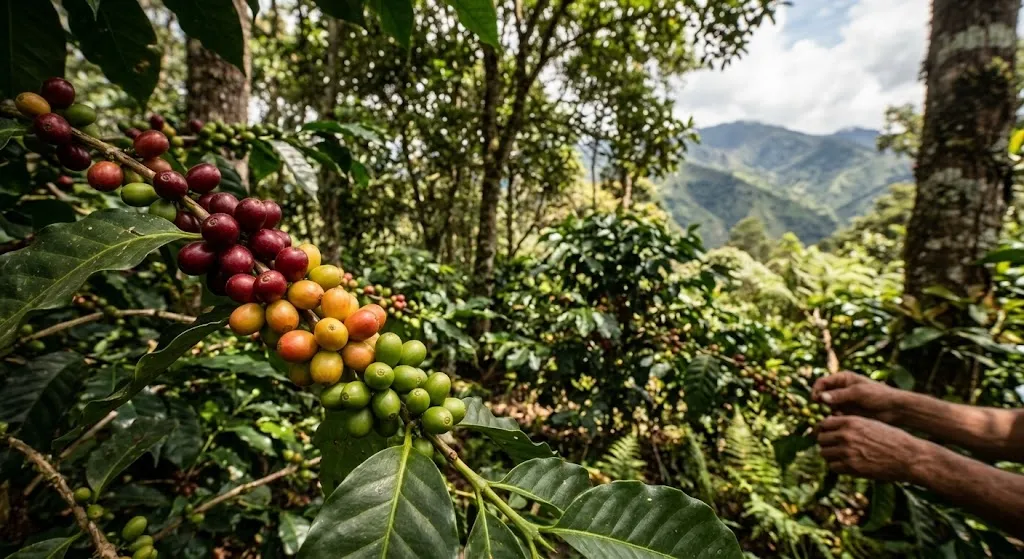
The recent Loja study examined farms in Chaguarpamba–Olmedo, Puyango and Quilanga–Espíndola and found considerable diversity in the tree species providing shade. Citrus and Inga were among the genera commonly represented, alongside other species whose importance varied by location.
This matters because “shade” is not a single agricultural practice. A coffee farm with sparse Inga trees is not equivalent to a densely shaded multi-species agroforestry system.
The canopy itself is part of the production system.
Shade and Aromatic Protection
For specialty coffee, one of the more interesting potential effects of shade is not simply sweetness.
It is moderation. A coffee developing under strong solar exposure can experience a different thermal and water environment from one growing under a managed canopy. In Loja, researchers found that shade moderated environmental fluctuations and reduced wind speed, suggesting that agroforestry systems create a more stable microclimate around the coffee plants.
This is particularly relevant for varieties already valued for aromatic complexity. A Typica Mejorado or Gesha does not need shade simply because it is a premium variety.
But when a producer is trying to preserve floral and fruit expression, maintaining a stable growing environment can become part of the agronomic strategy.
The relationship should still be treated carefully. There is no universal rule that shade makes Gesha more floral or Typica Mejorado sweeter.
The genetics remain fundamental. Soil matters. Elevation matters. Water availability matters. Nutrition matters. Harvest maturity matters. Processing matters.
Shade is one variable within that system.
The Canopy is Part of the Terroir
This is where agroforestry becomes more interesting than the generic phrase “shade-grown.”
A coffee farm can be described through its elevation, soil and climate.
But the vegetation structure is another layer of terroir. The trees growing above the coffee determine part of the environment immediately surrounding it.
The Loja research found significant tree diversity in coffee agroforestry systems and demonstrated that the characteristics of those systems were associated with differences in the microclimate.
In practical terms, a farm’s shade system can be described through:
canopy cover tree density tree species canopy height spatial distribution wind exposure slope and aspect
These are more informative than simply stating “shade-grown.” For buyers, this is an important distinction.
The question is no longer:
Does the farm have shade?
It becomes:
How does the farm’s canopy change the environment in which the coffee develops?
Shade × Altitude
Altitude and shade should not be treated separately. At high elevation, coffee already develops under a cooler thermal regime. Adding shade can further reduce daytime temperature and moderate the difference between exposed and protected environments.
But this does not mean that more shade is automatically preferable at higher altitude.
At some point, the limiting factor can become insufficient radiation rather than excessive heat.
That is why a well-designed agroforestry system is about balance. The ideal canopy is not necessarily the densest canopy.
It is the canopy that provides an appropriate microclimate for the specific farm.
For one Loja farm, moderate shade may help reduce heat and wind stress.
For another higher-elevation site, excessive canopy could reduce useful radiation and productivity.
This is another reason farm-level measurements are more useful than generic percentages.
The Microclimate Behind the Cup
The recent Loja study gives a useful indication of how significant the effect can be.
Across the monitored systems, researchers documented differences from full-sun conditions of roughly:
| Variable | Observed effect in Loja agroforestry systems |
|---|---|
| Air temperature | Approximately −4.23°C to +2.23°C relative to exposed conditions |
| Relative humidity | Approximately 0 to +10.54 percentage points |
| Wind speed | Lower under the agroforestry canopy |
| Environmental variability | More moderated under shade |
| Tree diversity | High, with significant variation among sites |
These are not values that should be copied directly onto an individual farm.
They are regional research observations demonstrating the scale of the microclimatic effect.
A specific farm needs its own measurements. And that is particularly important when trying to connect shade to cup quality.
What Does Shade Actually Do to the Cup?
This is where the science becomes more nuanced. A moderated microclimate can influence fruit development, but the final cup does not contain a simple “shade flavor.”
Instead, shade may alter the conditions under which the coffee plant produces and allocates metabolites during fruit development.
The sensory consequences may then appear as changes in:
perceived sweetness acidity balance body aromatic intensity fruit development
But those changes are conditional. The same amount of shade can produce different outcomes at different elevations, in different soils or with different varieties.
And processing can completely change how those differences are perceived. This is why it is more accurate to say:
Shade influences the conditions that shape cup quality.
rather than:
Shade creates sweetness.
That distinction is important when building a credible origin story.
Sombra and Sweetness: The Careful Version
The popular narrative says that slower ripening gives the coffee more time to accumulate sugars.
The biological reality is more complicated. Fruit development is a dynamic process involving photosynthesis, respiration, carbohydrate allocation, temperature and water status. Shade can alter those processes, but its effect on coffee quality is not universally positive or linear.
In some environments, moderate shade can improve the balance between plant stress and fruit development.
In others, excessive shade can reduce photosynthetic activity and productivity. The same applies to quality.
A well-managed shade system may support desirable conditions for maturation. But the cup still depends on the entire production chain.
This is precisely why data from Loja are more interesting than generic claims about “shade-grown coffee.”
The province provides a real-world example of shade changing measurable microclimatic variables around Arabica coffee.
Agroforestry as a Production System
The trees in a coffee farm are not merely decorative. They can form part of an integrated agroforestry system that influences:
microclimate soil cover organic matter inputs water dynamics biodiversity wind protection farm resilience
The Loja research documented considerable diversity among shade-tree communities and identified genera such as Citrus and Inga as important components of the systems studied.
This creates an important distinction between shade coffee and agroforestry coffee. Shade refers primarily to the environmental condition.
Agroforestry describes a broader production system in which trees and crops coexist and interact.
For a buyer interested in sustainability, that difference matters. The second question after “how much shade?” should be:
“What ecological function does the tree layer perform?”
The Forest Connection
In southern Ecuador, this discussion has another dimension. Loja includes landscapes associated with seasonally dry forests and other ecosystems under significant environmental pressure. Coffee systems that retain trees can contribute to maintaining vegetative cover and habitat connectivity, but the environmental benefit depends on how the farm is managed and what vegetation is actually being conserved.
It is therefore risky to equate every shaded coffee farm with forest conservation.
A plantation with a few shade trees is not the same thing as a biologically diverse agroforestry system.
The stronger sustainability story is measurable:
tree diversity canopy coverage retained native vegetation land-use history geospatial boundaries absence of recent deforestation
That approach also connects naturally with traceability requirements such as the EU Deforestation Regulation, where geographic location and land-use history become part of the compliance framework.
For Cafesure, this is where agroforestry can connect with the broader B.I.C. model: the environmental value is stronger when it can be documented rather than simply described.
Shade and Deforestation-Free Sourcing
There is an important conceptual difference between two statements: “This coffee is shade-grown.”
and “This coffee comes from a farm where the canopy, land use and production area are documented.”
The first is a marketing claim. The second can become traceability data.
Geolocation, farm boundaries, tree cover information and historical land-use analysis can help establish a more defensible sustainability narrative.
That is particularly relevant as buyers increasingly ask not only whether coffee is sustainable, but how the claim can be verified.
For producers operating in Loja, agroforestry therefore has a dual value:
agronomic value at the farm and traceability value in the supply chain.
Shade × Maturation: A Useful Working Model
The relationship can be visualized conceptually:
| Environment | Likely plant response | Potential cup implication |
|---|---|---|
| Full exposure / high heat | Higher thermal load and radiation | Faster development; potentially greater stress |
| Moderate managed shade | Cooler, less wind exposure, more stable humidity | Potentially more moderated maturation conditions |
| Dense shade | Lower radiation, higher humidity | Reduced productivity or disease risk if poorly managed |
| High altitude + moderate shade | Cooler baseline + canopy moderation | Potentially favorable for controlled maturation |
| High altitude + excessive shade | Very low thermal/radiation load | May limit productivity and photosynthetic performance |
The important word is potentially. This is a framework for understanding the farm, not a formula for predicting a cupping score.
Actual results require farm measurements and cup data.
What Buyers Should Ask
A serious buyer evaluating shade-grown coffee should be able to ask much more than:
“Is it shade-grown?”
Ask:
What percentage of canopy cover does the farm have? What tree species provide the shade? How dense is the canopy? Is the shade uniform across the farm? What is the elevation? What are the measured temperature and humidity conditions? How does harvest timing compare with exposed or differently shaded areas? Is native vegetation retained? Can the farm boundaries be georeferenced?
These questions turn “shade-grown” from a label into a production profile.
Shade and the Loja Cup
The relationship between shade and cup quality is not a straight line.
It is an interaction.
Shade modifies microclimate. Microclimate modifies plant development. Plant development influences cherry composition. Cherry composition interacts with processing. Processing determines how those characteristics are presented in the cup.
That is why two coffees from the same elevation can taste different even when both are “shade-grown.”
And it is why a good shade system should be considered part of terroir rather than a guaranteed flavor technology.
In Loja, the evidence is particularly useful because the effect is measurable.
Trees change the environment. The environment changes the coffee plant. And the coffee plant becomes the raw material from which the cup is ultimately built.
The Double Value of Shade
For specialty coffee, the most compelling aspect of agroforestry is that the same system can produce value on two levels.
In the cup: a moderated microclimate can contribute to the conditions under which high-quality coffee develops.
On the farm: trees can provide shade, wind protection, habitat and other ecosystem functions.
Neither benefit should be exaggerated. But together they create a much richer definition of sustainable coffee.
In Loja, the question is therefore not simply whether coffee grows under trees.
It is whether those trees are part of a well-managed production ecosystem whose effects can be measured from farm to cup.
That is a much stronger story. And it is the story behind genuinely traceable shade-grown coffee.
Continue Exploring Loja’s Terroir
The climate beneath the canopy is only one layer. Read Loja’s Microclimates: Where the Andes Meet the Amazon to understand how altitude, humidity and airflow shape the wider environmental gradient.
For the relationship between soil and cup, explore Volcanic Soil and the Minerality in Loja’s Cup.
For the environmental and compliance dimension, see Sustainable Coffee Exporter: The B.I.C. Model and EUDR Compliance and Deforestation-Free Coffee.
A Note on Farm-Level Data
The Loja research cited here provides regional evidence from three coffee-producing areas, including measured differences in temperature, relative humidity, wind and canopy conditions. It should not be used to assign a fixed shade percentage or temperature range to an individual farm.
For an individual lot, the most useful evidence is farm-specific: canopy cover, tree density and species, temperature, humidity, elevation, harvest timing and cup results.
That is where the connection between shade, sustainability and flavor becomes measurable.