Ecuador Coffee Harvest 2026: Buyer Guide
Quick Summary: As the 2026 coffee harvest progresses in southern Ecuador, production conditions are proving uneven across farms and locations. Some producers have experienced delays and lower volumes associated with irregular rainfall, while the performance and availability of specialty coffees continue to vary significantly by farm, variety, microclimate, and processing approach. This report provides a practical B2B guide to the current harvest, sample availability, varieties, quality observations, and shipment planning.
For specialty coffee buyers, following a harvest means more than knowing when cherries are being picked.
The commercially relevant questions are often much more specific: When will fresh lots become available? Which coffees are worth evaluating? How much volume is available? When can samples be approved? And when can the coffee actually ship?
At Cafesure, we work directly with producer partners in southern Ecuador and follow the crop at farm and processing level. This allows us to evaluate coffees as individual lots rather than treating the Ecuadorian harvest as a single, uniform crop.
The 2026 season is particularly interesting because weather conditions have not affected every location in the same way. Reports from southern Ecuador have pointed to delays and reduced production in some areas associated with rainfall, while harvest activity continues through the later part of the season.
For buyers, this makes lot-level sourcing and real-time availability more important than broad assumptions about the crop.
For broader climate and global-market context, see our report on El Niño 2026 and the Global Coffee Market.
The 2026 Harvest at a Glance
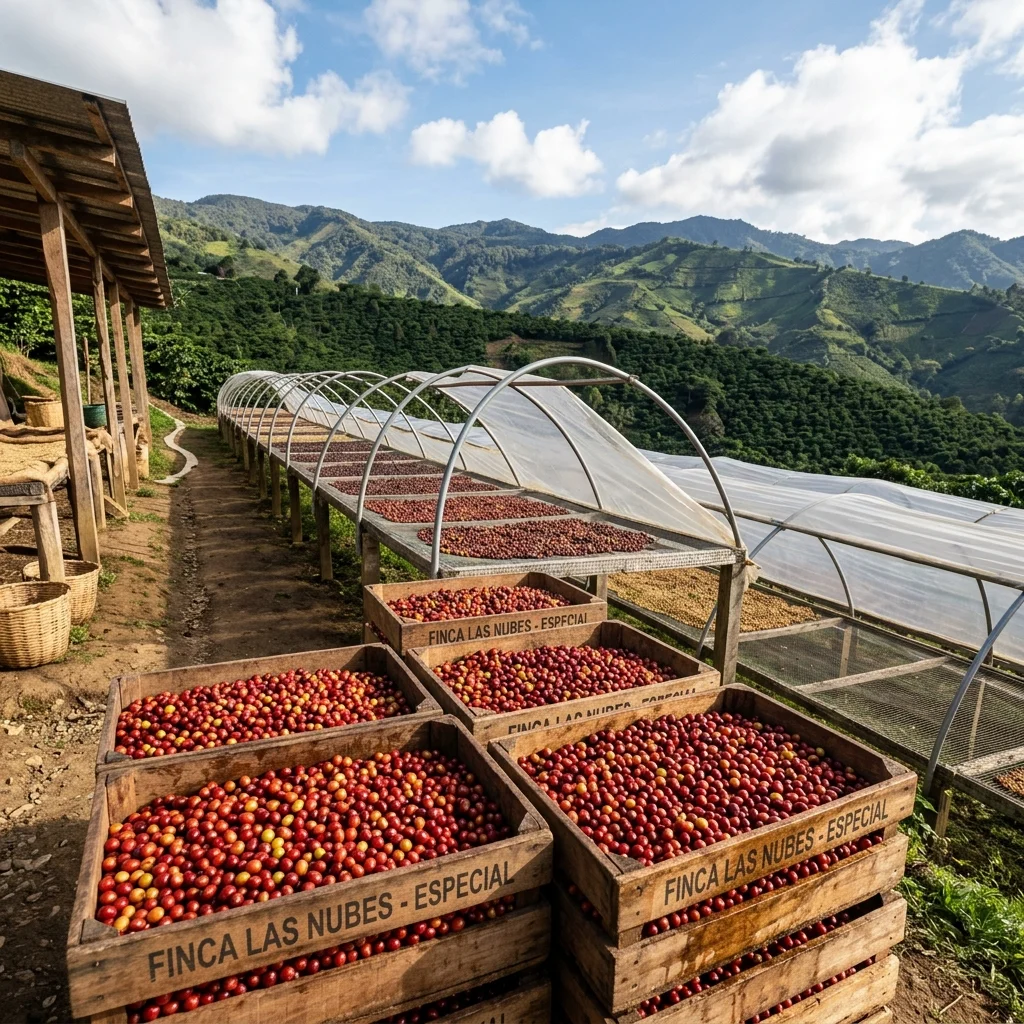
The main coffee harvest in southern Ecuador generally extends through the middle and later part of the year, with a significant share of activity taking place from May through September. The exact timing varies by location, farm conditions, variety, rainfall, and local microclimate.
For Loja, this seasonal window is particularly relevant to international buyers because processing, drying, stabilization, milling, and export preparation continue after the cherries leave the tree. As a result, the arrival of a fresh crop on the green-coffee market extends beyond the physical harvest itself.
Key indicators for buyers
- Main harvest window: May–September, with substantial activity during the middle of the year.
- Harvest conditions: Uneven across locations, with some producers reporting delays and lower volumes.
- Specialty availability: Determined at farm and lot level rather than by a single regional harvest date.
- Current sourcing focus: Washed coffees, honeys, and selected controlled experimental fermentations.
- Export readiness: Generally follows processing, drying, stabilization, milling, and quality-control stages, placing much of the fresh-crop export window in the second half of the year.
The important distinction is that harvest date and export-ready availability are not the same thing.
What Is Happening in the 2026 Crop?
Coffee production in southern Ecuador is shaped by highly variable local conditions. Farms located within the same province can experience different rainfall patterns, flowering dates, ripening speeds, and harvest timing.
During the 2026 season, some producers in the south have reported delays and lower production following irregular rainfall. Public reporting in June described the harvest as starting later than expected in parts of the region, with collection expected to continue into September.
At the same time, this does not mean that every specialty lot is experiencing the same outcome.
For specialty buyers, the relevant question is not simply whether regional production is up or down. It is:
Which farms and lots are available, in what volume, with what quality, and when can they be shipped?
This is why Cafesure evaluates the season through individual farms, varieties, harvest periods, processing methods, and cup performance.
Flowering, Ripening, and Harvest Timing
Coffee flowering in Ecuador can occur through multiple events rather than one perfectly synchronized flowering period.
Rainfall following dry conditions can stimulate flowering, while subsequent weather influences fruit development and ripening. Because these conditions vary between farms, harvest dates can also be staggered.
For specialty coffee, this creates an important operational principle: Harvest timing should follow fruit maturity rather than a fixed calendar date.
Selective picking allows producers to separate ripe cherries from fruit that requires additional time on the plant. In turn, this helps processors create more consistent lots and preserve the distinctions between different harvest periods.
At Cafesure, harvest information is considered alongside variety, farm block, processing method, and cup evaluation when determining which coffees should become part of the export offer.
Quality Is Farm-Specific
There is no single “2026 Ecuadorian cup profile.” Ecuador contains a wide range of growing environments, varieties, production systems, and processing traditions. Even within Loja, two nearby farms can produce coffees with substantially different sensory characteristics.
Altitude is an important environmental factor, but it should not be treated as a guarantee of quality.
The same is true for variety or processing method. A compelling specialty coffee is the result of several factors working together:
genetics + growing conditions + farm management + fruit maturity + harvesting + processing + drying + storage + quality control.
This is why Cafesure evaluates coffee at the lot level. The objective is not to promise a particular cup because a coffee comes from a certain altitude or variety. It is to identify the lots that are actually performing well and present buyers with enough origin information to make an informed purchasing decision.
What We Are Seeing in Selected 2026 Lots
Current evaluations from selected lots in our sourcing network show a diverse range of expressions rather than one dominant seasonal profile.
Among coffees performing strongly in the cup, we are seeing combinations of:
- Floral and white-flower aromatics.
- Citrus and stone-fruit acidity.
- Ripe fruit and panela-like sweetness.
- Tea-like structures in some delicate lots.
- Creamy or syrupy mouthfeel depending on variety and process.
- Clean and transparent washed coffees alongside more expressive honey and controlled experimental processes.
These observations should be understood as lot-level results, not as a prediction for every coffee produced in Ecuador during 2026.
The same variety can express differently from one farm to another. Processing can also shift the balance between acidity, sweetness, body, and aromatic intensity.
For a buyer, the practical implication is simple: Evaluate the coffee itself, not only its origin label.
Monitoring Maturity at Origin
At Cafesure, Brix is used as one of several tools to monitor cherry maturity during harvest.
It is not treated as a standalone definition of quality. Depending on the lot, maturity evaluation can incorporate:
- Visual cherry maturity.
- Fruit uniformity.
- Density and physical characteristics.
- Brix measurements.
- Harvest timing.
- Processing behavior.
- Cup evaluation.
This combination provides a more complete picture than relying on a single numerical threshold.
For buyers, this also means that a Brix figure is most useful when it is accompanied by information about how and where it was measured, together with the variety, harvest condition, and processing method.
2026 Varieties: Availability and Buyer Fit
Ecuador’s specialty segment is particularly interesting because of the range of varieties available to buyers.
For Cafesure, the focus is not simply on variety names but on matching individual lots with the right roasting application.
| Variety | Availability in our 2026 offer | Typical observed expression | Potential buyer fit |
|---|---|---|---|
| Typica Mejorado | Limited | Floral, stone fruit, bright acidity, pronounced sweetness | Premium filter, single-origin programs |
| Sidra | Limited | Aromatic, fruit-driven, sweet, creamy to syrupy | Specialty filter, espresso, premium single origin |
| Gesha | Very limited | Tea-like, floral, delicate, highly aromatic | Boutique and high-end specialty programs |
| Caturra & Bourbon | Broader availability | Sweet, balanced, chocolate and fruit notes | Filter, espresso, blends, everyday specialty programs |
Availability refers to coffees within our sourcing network and may vary during the season according to farm production and lot allocation.
For more background, explore our guide to Ecuadorian coffee genetics and heritage varieties.
Processing and Lot Separation
Harvest variability increases the importance of careful lot separation. At origin, coffees can be differentiated by:
- Producer and farm.
- Variety.
- Harvest period.
- Processing method.
- Fermentation protocol.
- Drying conditions.
This separation allows the sensory identity of each coffee to remain clear and provides buyers with more useful traceability.
At Cafesure, the objective is to connect the physical coffee with its origin information, processing history, quality evaluation, and export documentation.
For buyers sourcing multiple Ecuadorian coffees, this makes it easier to compare lots based on their actual characteristics rather than relying on broad regional descriptions.
From Harvest to Export
The journey from cherry to export-ready green coffee involves several stages:
Harvest
Ripe cherries are selectively collected according to the condition of the fruit and the producer’s harvesting strategy.
Processing and drying
The coffee is processed according to the selected method and dried under controlled conditions appropriate to the lot.
Stabilization
Following drying, parchment coffee is allowed to stabilize before final preparation.
Quality evaluation
The coffee is assessed for physical characteristics and cup quality before being approved for an export program.
Milling and preparation
Approved lots are milled, prepared, packed, and documented according to shipment requirements.
Export
The finished coffee enters the export process once it has completed the necessary quality and logistical controls.
This explains why harvest availability should always be discussed together with sample readiness and shipment readiness.
A coffee may already have been harvested while still requiring additional time before it is ready for final purchasing and export.
Sample and Shipment Planning for the 2026 Crop
For importers and roasters, the best sourcing strategy is usually to coordinate sample evaluation with the expected availability of export-ready lots.
| Stage | Typical 2026 window | Recommended buyer action |
|---|---|---|
| Harvest and processing | May–September | Monitor lots by farm, variety, and process |
| Drying and stabilization | Following harvest | Confirm expected sample and shipment readiness |
| Offer and PSS samples | During the second half of the harvest period | Evaluate samples and approve target lots |
| Export preparation | Second half of the year | Finalize purchasing and logistics planning |
For international buyers, early communication is particularly useful when the target is a limited-volume variety or a specific producer.
Global Supply vs. Specialty Availability
The global coffee market and the specialty coffee market should not be treated as the same thing.
The USDA currently forecasts record world coffee production for the 2026/27 marketing year, while Ecuador remains a relatively small producer compared with the world’s largest origins.
But global volume does not tell a buyer whether a particular Ecuadorian Typica Mejorado, Sidra, Gesha, or farm-separated micro-lot will be available.
For specialty coffee, supply is often constrained at the lot level, not at the global level.
This creates an important sourcing distinction: A market can have abundant coffee overall while individual specialty coffees remain scarce.
For roasters, this is why direct relationships, early sample evaluation, and advance allocation can matter even when global supply appears comfortable.
Ecuador’s opportunity is therefore not primarily to compete with the world’s largest producers on volume.
It is to provide differentiated coffees where origin, traceability, varieties, processing, and sensory identity have greater value.
Why Early Sourcing Matters
Specialty coffee availability is inherently limited. A producer may have only a small amount of a particular variety or process. Once that coffee is allocated, the next comparable opportunity may not be available until another harvest.
Early sourcing can give buyers more time to:
- Evaluate samples with their QC team.
- Develop roast profiles.
- Compare coffees from different farms.
- Plan purchasing quantities.
- Coordinate financing and logistics.
- Secure specific lots before they are allocated elsewhere.
This does not mean that every buyer needs to reserve coffee before evaluating it.
It means that the earlier the communication starts, the more options remain available.
What Buyers Should Ask for
When evaluating Ecuadorian coffee from the 2026 crop, we recommend asking for more than a country and variety.
Useful information includes:
- Farm and producer: Where exactly was the coffee produced?
- Variety: What genetic material is represented in the lot?
- Harvest period: When was the coffee harvested?
- Processing method: Washed, honey, natural, or experimental?
- Physical specifications: What are the moisture, screen, preparation, defect, and density characteristics?
- Cup evaluation: What does the coffee actually taste like?
- Available volume: How much of the lot is currently available?
- Shipment readiness: When can the coffee realistically be prepared and exported?
This information gives buyers a clearer basis for comparing coffees and planning their programs.
What 2026 Means for Ecuadorian Specialty Coffee
The most useful conclusion from the 2026 harvest is not that every Ecuadorian coffee will follow one seasonal pattern.
It is that variation between farms and lots remains fundamental to sourcing from Ecuador.
Weather conditions can affect producers differently. Varieties can respond differently. Processing can create very different sensory results. And volumes can vary significantly from one producer or lot to another.
For buyers, this creates both a challenge and an opportunity. The challenge is that broad statements about “Ecuadorian coffee” rarely provide enough information to make a purchasing decision.
The opportunity is that Ecuador offers a diverse set of producers, varieties, growing environments, and processing approaches that can be evaluated individually.
For Cafesure, that is where our role as an exporter based at origin becomes valuable.
We work to identify promising coffees during the harvest, evaluate them at origin, preserve lot-level traceability, and connect international buyers with coffees that fit their quality, profile, volume, and delivery requirements.
Request the 2026 Ecuador Harvest Offer
The most reliable way to understand the 2026 crop is to evaluate the coffees themselves.
Cafesure is currently working with producer partners in southern Ecuador to identify available lots and match them with international roasters and importers according to profile, variety, processing method, volume, and shipment requirements.
Request the current 2026 harvest offer and available samples from our sourcing team.
For broader regional information, see our Loja Coffee Guide. For sourcing timelines, see our Ecuador Coffee Sourcing Calendar.
For the global climate and market context, read El Niño 2026 and the Global Coffee Market.