Private Label Coffee Manufacturing Ecuador
Quick Summary: Complete guide to private label coffee manufacturing in Ecuador. MOQ 500 kg per SKU, custom blends, one-way degas valve packaging, FDA compliance, and air freight to US. Manufacture at origin and save.
For coffee brand owners, whether you are launching a specialty coffee line, expanding a roastery brand into new channels, or developing a foodservice program, the manufacturing decision usually comes down to a choice between domestic co-packers in the US or building your own roasting capacity. Both options carry constraints. US co-packers offer convenience but high per-pound costs and limited varietal access. Building your own roastery requires capital equipment, ventilation, fire suppression, trained staff, and months of commissioning. For a detailed comparison of these two paths, see our breakdown of roastery vs. packing center economics.
There is a third option: private label coffee manufacturing in Ecuador, directly at origin. This guide covers what that actually means for a brand owner, the MOQs, the packaging options, the blend development process, the regulatory requirements for US import, and the economic math that makes roasting in Loja a viable alternative to domestic co-packing.
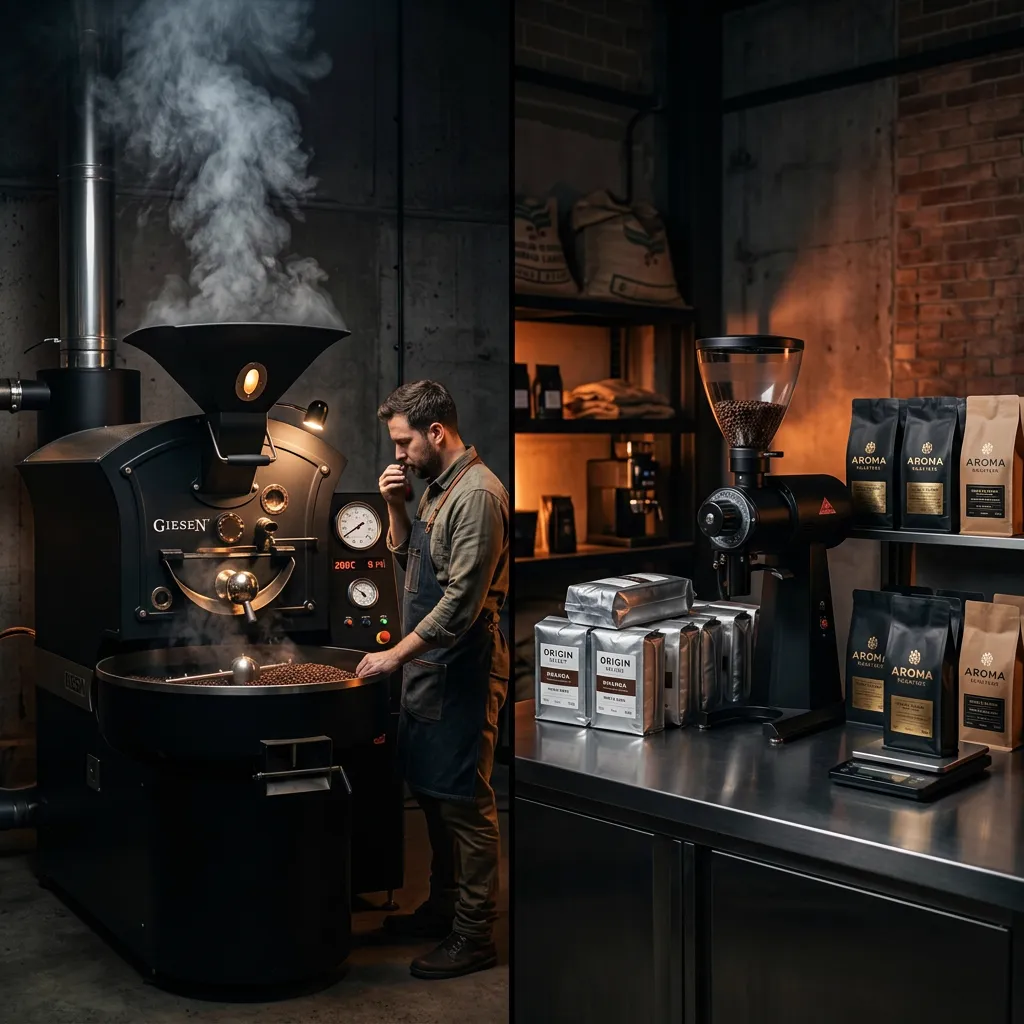
We manufacture private label coffee at our facility in Loja, southern Ecuador, for brand owners in the United States, Canada, the Middle East, and Asia. This is not green bean export with a sticker on it. We roast, package, label, and ship finished consumer-ready products under your brand name, directly from origin.
Why Manufacture Private Label Coffee at Origin
Most brand owners default to US-based co-packing for one reason: it is the familiar path. But the familiar path has structural inefficiencies that origin manufacturing addresses directly.
Cost structure. A US co-packer charges for green coffee procurement (typically with their margin built in), roasting time (per-pound fee), packaging materials (marked up), warehousing, and fulfillment. When you manufacture at origin, the green coffee cost is the FOB export price, no importer margin, no domestic warehousing. Roasting labor in Ecuador is lower than US-equivalent skilled labor. The result: all-in landed cost per pound of finished roasted coffee can be 18% to 30% lower than a comparable US co-packing arrangement, depending on volume and SKU complexity.
Variety access. US co-packers roast from inventory they hold. If they do not carry the specific components needed to achieve your signature profile, they cannot roast it for you. When you manufacture at origin, your roastery is 60 km from the farms. You can formulate blends using lots that never enter the commodity supply chain, ensuring your house roast is truly unique to your brand.
Speed to market. Air freight from Quito to Miami, New York, or Los Angeles takes 3 to 5 business days. That is faster than cross-country trucking from many US co-packer locations. For a brand owner launching a seasonal limited-release, origin manufacturing compresses the supply chain from farm to branded bag.
Supply chain control. You contract directly with the exporter who owns the roasting facility. There is no intermediary between the farmer and your finished product. Your blend formulation, roast profile, and packaging spec are managed by one team, in one facility, under one quality program.
MOQ, Bag Sizes, and SKU Requirements
Private label manufacturing has minimums that reflect real production economics, grinding, blending, bagging, and degassing have setup costs per run. Our current MOQ structure:
Minimum Order Quantities
| Order Type | MOQ | Typical Use Case |
|---|---|---|
| Pilot / first SKU launch | 250 kg (≈550 lbs finished) | New brand testing a single SKU |
| Standard production run | 500 kg per SKU (≈1,100 lbs) | Core line extension or new SKU |
| Multi-SKU order | 1,000 kg total across 2–4 SKUs | Full product line launch |
| Full container (FCL) | 5,000–6,000 kg (custom) | Wholesale / foodservice program |
Pilot runs (250 kg) carry a 10–15% premium per unit to cover setup and sampling overhead. At 500 kg per SKU and above, unit economics normalize.
Available Bag Sizes
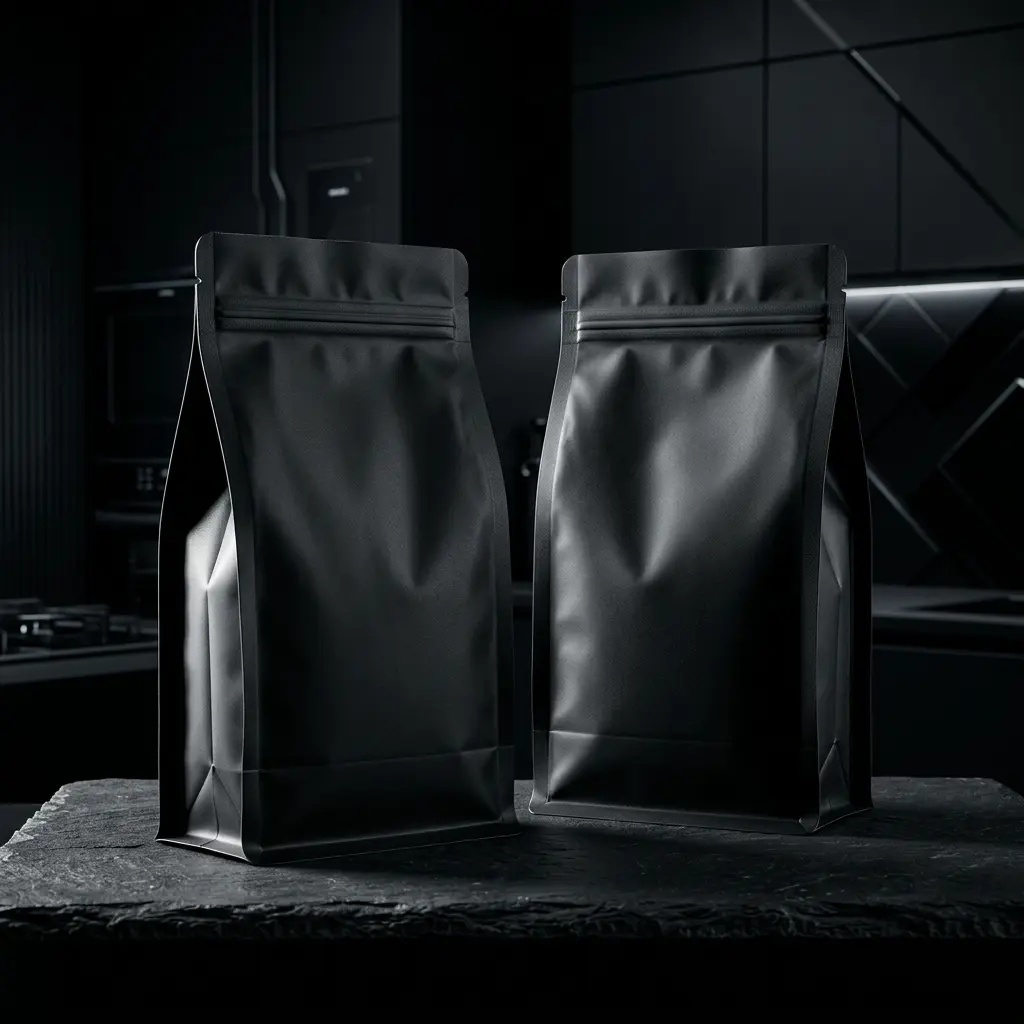
We run the following formats, all packaged in stand-up pouches with one-way degas valves:
-
250 g (8.8 oz): retail / e-commerce
-
340 g (12 oz): standard US specialty retail
-
454 g (1 lb): US market standard
-
500 g (17.6 oz): European / Middle East market standard
-
1 kg (2.2 lb): foodservice / bulk retail
-
5 kg (11 lb): gastronomy / office / HORECA
All bag sizes are run on the same packaging line with programmable fill weights. Switching between formats for a production run requires a 30-minute line changeover, which we batch to minimize downtime.
Degas Valve
Every private label bag includes a one-way degas valve as standard. The valve allows CO₂ to escape without letting oxygen in, preserving freshness during transit and shelf storage. We use WIPF or equivalent one-way valves. If your brand requires a specific valve supplier, we can accommodate at volume.
Custom Blend Development and Sample Roast Process
A private label program is only as good as the coffee inside the bag. Our blend development process is designed to produce a repeatable, documented formulation that your customers will recognize from order to order.
Step 1: Flavor Profile Brief
You provide a target profile. The more specific, the better. Instead of “medium roast,” tell us:
-
Body: Heavy and syrupy, or light and tea-like?
-
Acidity: Bright and citrus-forward, or mild and balanced?
-
Finish: Long and sweet, or clean and short?
-
Intensity: Do you want a bold, traditional dark roast, or a more delicate, modern light-medium profile?
-
Score target: SCA 84+ (entry specialty), 86+ (core specialty), or 88+ (ultra-premium)?
Step 2: Component Selection
From our direct relationship farms in Loja and surrounding provinces, we select candidate green components that match your desired sensory profile. Our current inventory allows us to build blends across the entire specialty spectrum:
-
Classic & Comforting: Deep chocolate, caramel, and roasted nuts with heavy body. Excellent for traditional espresso and milk-based drinks.
-
Balanced & Sweet: Stone fruit, brown sugar, and smooth acidity. The perfect foundation for an everyday “House Blend”.
-
Bright & Complex: Floral notes, red berries, and vibrant acidity. Ideal for modern filter roasts and specialty single-origins.
Because we roast at origin, every blend we produce is 100% single-origin Ecuadorian coffee, allowing you to market a pure, traceable product.
Step 3: Sample Roast and Cupping
Our QC team roasts 3 to 5 candidate blend ratios on a sample roaster, cupping each against your target profile. We send you:
-
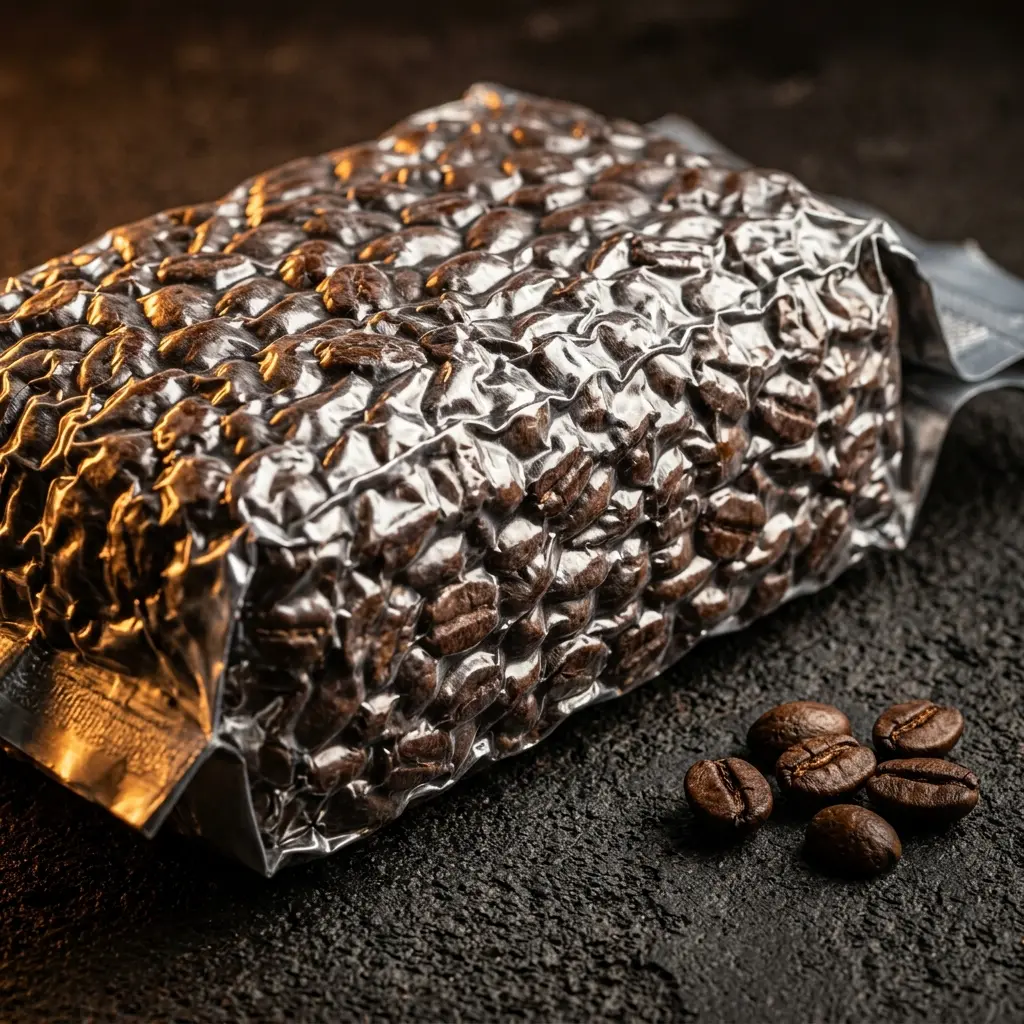
300 g of each candidate blend, vacuum-sealed
-
Roast log (charge temp, development time ratio, drop temp)
-
Cupping scores (SCA protocol) for each candidate
-
Blend composition by percentage and variety
Step 4: Iteration and Sign-Off
You cup the candidates blind (ideally against a reference coffee you already stock). We iterate on the winning candidate until the profile is signed off. Once approved, the blend formula is documented with a blend ID, component sourcing instructions, roast profile, and target density.
Step 5: Production Confirmation Roast
Before each production run, we roast a confirmation batch and send you a 300 g sample. Production proceeds only when you confirm the sample matches the signed-off profile. This is non-negotiable, every production run is bracket-checked against the reference.
Packaging Options: Custom Bags vs. Labeled Bags
We offer two packaging tiers, designed around your brand’s stage and volume.
Tier 1: Custom Printed Stand-Up Pouches
For brands at scale, full-color custom-printed pouches deliver stronger shelf presence.
-
MOQ: 5,000 units per design (can be split across bag sizes at proportional pricing)
-
Print: Rotogravure or flexographic, up to 10 colors, inside or outside print
-
Material: Multi-layer laminate with aluminum foil barrier or metalized PET
-
Options: Matte or gloss finish, window cutout, resealable zipper, custom degas valve color
-
Lead time: 4 to 6 weeks from artwork approval to pouch delivery at origin
-
Cost: $0.18–$0.35 per pouch depending on size, quantity, and finish
Tier 2: Plain Kraft Pouch with Custom Label
For brands launching their first SKU or testing a new channel, this tier keeps MOQs low and cash commitment minimal.
-
MOQ: 500 labels per SKU (we print and apply)
-
Bag: Plain kraft or white stand-up pouch with degas valve (stock item, no MOQ)
-
Label: Full-color pressure-sensitive label, matte or gloss, cut to shape
-
Lead time: 1 to 2 weeks for label printing
-
Cost: $0.08–$0.12 per pouch (bag + label), no large-format printing commitment
We also offer private-label nitrogen-flushed retail-ready cartons (12-bag or 24-bag display cartons) for foodservice and grocery channel programs.
Quality Control and Food Safety
Our roasting facility operates under a documented quality management system aligned with HACCP principles. Every private label production run is tracked through:
-
Green intake QC: Moisture content (target 10–12%), water activity (Aw < 0.70), screen size, defect count per 300 g sample
-
Roast profile logging: Every batch is logged on a digital roast recording system. Charge temperature, rate of rise (RoR), turning point, development time ratio (DTR), and drop temperature are recorded and stored per batch
-
Post-roast QC: Agtron color reading (whole bean and ground), moisture loss calculation, cupping confirmation by licensed Q-Grader
-
Packaging QC: Seal integrity test (each production shift), gas flush oxygen residual (< 2% if nitrogen flushed), label accuracy audit per pallet
-
Lot traceability: Every bag is marked with a production lot code that traces to the green intake lot, roast batch, and packaging run
Certifications and Registrations
-
FDA Food Facility Registration: active and current
-
HACCP-based food safety plan: documented and audited internally each quarter
-
B.I.C. (Benefit and Collective Interest Company): triple-impact legal structure, verified sustainability compliance
Regulatory Pathway for US Import of Private Label Roasted Coffee
Importing finished roasted coffee into the United States follows a different regulatory pathway than green coffee. Here is what your customs broker will need.
FDA Requirements
-
Prior Notice: Must be filed before the shipment arrives. Your US customs broker files this through the FDA Prior Notice System Interface. We provide our FDA registration number, facility address, and product details.
-
Food Facility Registration: Our roasting facility maintains an active FDA registration. We provide the registration number and the Unique Facility Identifier (UFI) on request.
-
Labeling Compliance: Roasted coffee sold in the US must comply with 21 CFR 101, including a statement of identity, net quantity of contents, nutrition facts panel (if any nutrition claims are made), ingredient list (if blended with flavorings), and manufacturer/distributor name and address. We design all labels to comply with FDA labeling regulations. Final label artwork is reviewed internally before production.
US Customs Requirements
-
HS Code: Roasted, not decaffeinated coffee classifies under 0901.21 (same as green). Roasted, decaffeinated is 0901.22. Confirm with your broker.
-
Duty Rate: Roasted coffee from Ecuador enters the US duty-free under current trade preferences. Rates can change; confirm with your broker at time of entry.
-
Country of Origin Marking: Each retail bag must be marked “Product of Ecuador” or “Roasted and Packed in Ecuador” in a conspicuous location.
-
FDA Detention Without Physical Examination (DWPE): While uncommon for roasted coffee, if FDA has reason to suspect contamination, the shipment may be detained. Our QC documentation and lot traceability are designed to respond to FDA inquiries within 24 hours.
Documentation Package Per Shipment
We provide with each shipment:
-
Commercial invoice (with HS code 0901.21, value, gross/net weight)
-
Packing list (bag count, SKU breakdown, pallet configuration)
-
Certificate of Origin (for duty preference)
-
FDA Food Facility Registration confirmation
-
Lot-specific roast and packaging records
-
Air waybill or bill of lading
Economics: Origin Manufacturing vs. US Co-Packing
Below is a qualitative comparison of the cost structure for a brand owner producing private label coffee at origin versus using a domestic US co-packer.
-
Green Coffee Cost: With a US co-packer, you pay the importer’s markup on the green coffee. With origin manufacturing, you pay the FOB export price.
-
Roasting & Packaging Fees: US co-packers charge premium labor rates per pound roasted. In Ecuador, the skilled roasting labor is more cost-effective, and the roasting fee is built into a single, transparent per-unit price.
-
Warehousing: US co-packers charge monthly pallet storage fees. Origin manufacturing ships directly to your fulfillment center or distributor, bypassing domestic intermediate warehousing.
While air freight from Ecuador to the US is higher than domestic trucking, the savings on the green coffee margin and roasting labor more than offset the shipping cost. The all-in cost advantage ranges from roughly 18% to 30% per pound, and for a 500 kg production run, that is a real difference that significantly improves your brand’s gross margin. At scale across multiple SKUs and repeat orders, the savings compound.
Start Your Private Label Program
If you are evaluating private label coffee manufacturing, the fastest path is to start with a brief. Tell us about your brand, your target flavor profile, and your volume expectations. We will send you three candidate blend samples roasted to your spec, along with a pricing proposal for your target SKU configuration.
Contact our team directly to discuss your private label program, or explore our roasted coffee programs page for an overview of our production capabilities.
For brand owners interested in the full supply chain, see how our direct trade model and lot-level traceability ensure every bag you sell has a documented chain of custody from farm to consumer.