Bulk Roasted Coffee From Ecuador
Quick Summary: Source bulk roasted coffee from Ecuador. Vacuum bricks, GrainPro bags, and private-label programs for US brands and retailers. MOQs from 100 kg. Roasted to order in Loja.
For US coffee brands, online stores, distributors, and gourmet retailers looking to offer single-origin specialty coffee under their own label, sourcing bulk roasted coffee from Ecuador is the most efficient path. It bypasses the need for domestic roasting facilities or local co-packers, giving you direct access to premium, consistent sensory profiles, roasted to your specifications in Loja and air-freighted to your door in under two weeks.
This guide covers the practical details: MOQs, packaging formats, the bulk vs private-label decision, logistics timelines, quality control protocols, sample roasting, and a direct cost comparison against US-based co-packers.
The Value Proposition: Why Source Roasted Coffee from Origin
For brand owners, e-commerce stores, and specialty retailers, setting up a roasting facility requires high capital investment, complex environmental permits, and ongoing labor overhead. Sourcing roasted coffee directly from Ecuador provides an instant, premium production line with significant commercial advantages.
The key advantages over local co-packing:
-
Direct profile access. Sourcing directly from the origin lets you offer exclusive, consistent flavor profiles (from deep chocolate espresso blends to bright fruity filter roasts) without competing with major green importers for allocation.
-
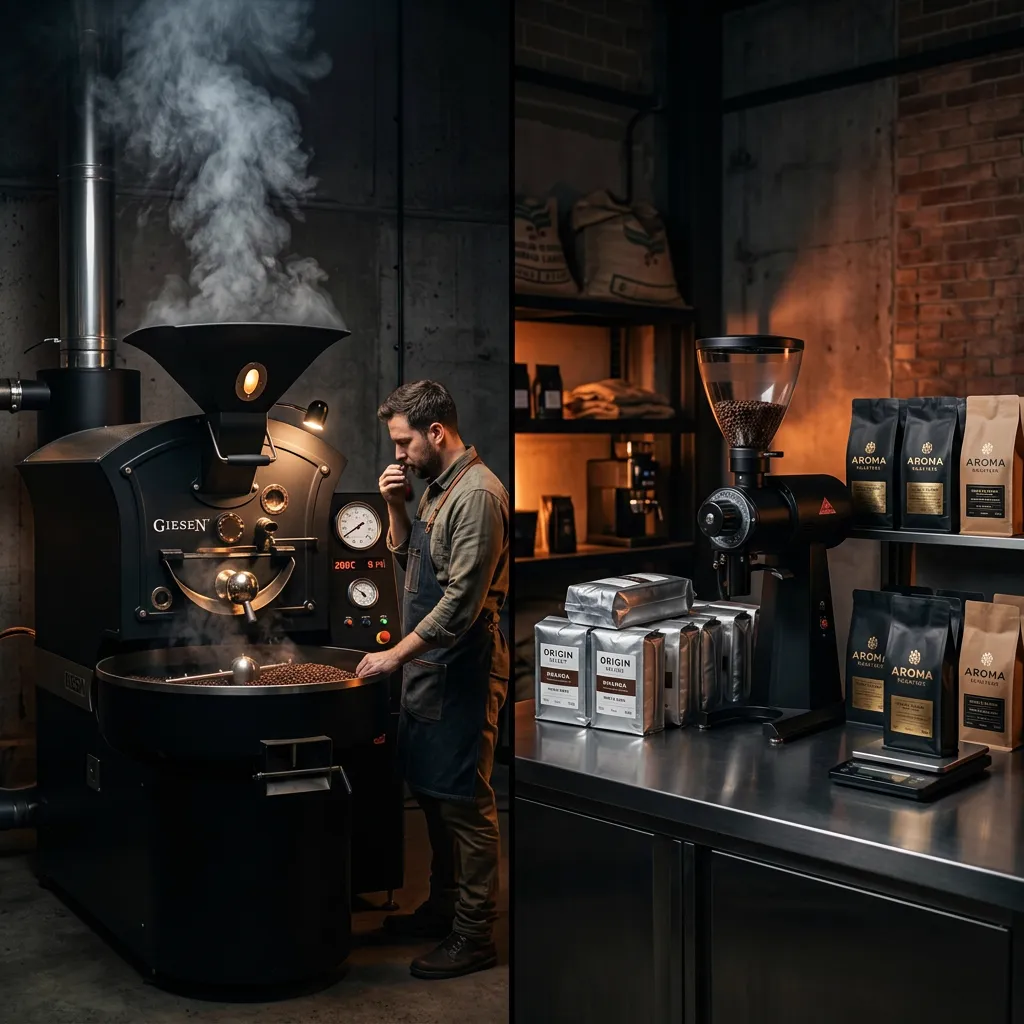
Roasted at origin. Roasting and packaging at the dry mill in Loja ensures the beans are sealed in a climate-controlled environment immediately after roasting, locking in freshness before they undergo transit.
-
No intermediary markup. Buying directly from the exporter-roaster eliminates the importer, distributor, and local co-packer margins. You pay for the green coffee plus a highly competitive origin roasting cost.
-
Air-freight speed. Roasted coffee is air-freighted from Quito to US ports, arriving in 5 to 10 business days, a timeline comparable to domestic truck shipping from a local co-packer in another state.
-
Capital efficiency. You can launch or scale your coffee brand without investing in roasters, industrial gas lines, packaging machinery, or roasting staff.
The model is simple: you focus on branding, marketing, and distribution, while we handle the agricultural sourcing, roasting, and packaging at the source.
Packaging Formats and MOQs
We offer three standard packaging formats for bulk roasted coffee. Each serves a different channel and shelf-life requirement.
Vacuum Bricks (Standard Bulk)
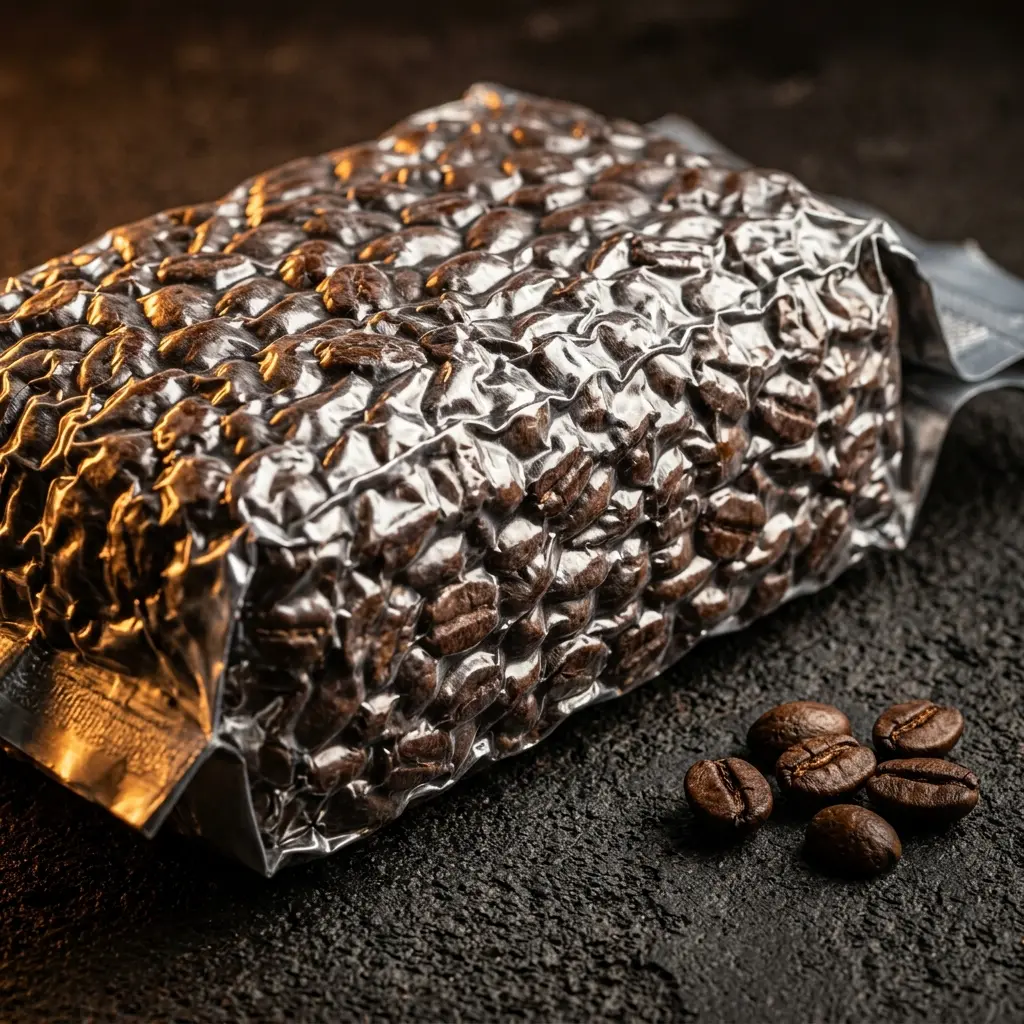
Vacuum-sealed bricks are the most space-efficient format for bulk transport and offer the longest shelf life. Each brick is nitrogen-flushed and heat-sealed in a multilayer barrier film.
-
Weight: 5 kg per brick (standard), custom weights available on request
-
Packaging: 4 to 6 bricks per carton, palletized and stretch-wrapped
-
Shelf life: 12 to 18 months sealed, 30 days after opening
-
MOQ: 100 kg (20 bricks)
GrainPro Bags (High-Volume Bulk)
For larger volumes where per-unit packaging cost matters, GrainPro hermetic bags are the economical choice. These are the same bags we use for green coffee export, adapted for roasted coffee with a one-way degassing valve.
-
Weight: 30 kg per bag
-
Packaging: Palletized with corner boards and straps
-
Shelf life: 6 to 9 months sealed
-
MOQ: 300 kg (10 bags)
Retail Valve Bags (Private Label)
For brands that want to receive ready-to-sell retail stock, we offer custom-printed valve bags with your branding. This eliminates the packaging and labeling step at your warehouse entirely.
-
Weight: 227 g (8 oz), 340 g (12 oz), or 454 g (1 lb), standard retail sizes
-
Packaging: 12 bags per carton, cartons palletized
-
Shelf life: 3 to 6 months on shelf
-
MOQ: 500 kg per SKU for custom print; 250 kg for stock bags with label overstick
Bulk Roasted vs Private Label: When Each Makes Sense
The decision between bulk roasted (you weigh and bag at your facility) and private label (we bag in your branded retail packaging) depends on your operation’s size and your logistics setup. For a detailed cost comparison of both paths and the unit economics at different volumes, see our breakdown of roastery vs. packing center economics.
| Factor | Bulk Roasted | Private Label | Winner |
|---|---|---|---|
| MOQ | 100 kg | 500 kg per SKU | ✅ Bulk (lower entry) |
| Packaging | Standard vacuum brick or GrainPro | Custom-printed retail bags | |
| Labor Required | You weigh, bag, and label at your warehouse | Ready to sell on arrival | ✅ Private Label (turnkey) |
| Shelf-life Control | You manage after opening | Managed at origin | ✅ Private Label (prolonged) |
| Branding | None (bulk format) | Full retail branding | ✅ Private Label |
| Cost per kg | Lower (no bagging, no retail packaging) | Higher (includes retail materials and labor) | ✅ Bulk (economics) |
| Best For | Coffee brands with local packing facilities | Direct-to-consumer, retail, e-commerce |
For a coffee brand testing a new Ecuadorian single-origin offering, starting with bulk roasted vacuum bricks is the lower-risk path. Once the product is validated in the market, a private-label run gives you a turnkey, retail-ready product.
The Quality Control Process
One concern we hear from brand owners is: “How do I ensure the roast profile and cup quality remain consistent without hands-on roasting?” We address this through a structured quality control protocol that mirrors a professional co-packing relationship.
Step 1: Roast Profile Alignment
We work with you to establish your brand’s target roast profile. You can share your desired flavor specifications (e.g., “heavy body with dark chocolate” or “sweet with stone fruit notes”). Our Q-Graders roast a test batch at our facility in Loja, measure it against your targets, and ship you a roasted sample for cupping and feedback.
Step 2: Profile Lock
Once you approve the test roast, we lock the profile in our roast logging system, recording charge temperature, roast duration, rate-of-rise (RoR) curve, development time ratio (DTR), and final drop temperature. Every subsequent production batch is roasted to match this exact profile.
Step 3: Production QC
Every production batch is checked against three metrics before packaging:
-
Agtron whole-bean and ground color: must land within ±2 points of the locked target.
-
Moisture loss: tracked per batch to confirm consistency.
-
Cupping score: a 100 g sample from each batch is cupped by our Q-grader and scored against the baseline.
Batches outside spec are held and re-blended or re-roasted at origin. Only in-spec batches ship.
Step 4: Pre-Shipment Sample
A 500 g sample from the production run is shipped to you by express courier before the main cargo departs. If it does not match your expectation, we adjust before the bulk shipment leaves Quito.
This QC loop is designed to catch any deviations at origin, ensuring the coffee arriving at your warehouse matches your exact specifications.
Logistics Chain: Loja to Your Warehouse
The physical journey of bulk roasted coffee from our facility in Loja to your US facility follows a defined chain:
-
Roasting & packaging at our facility in Loja, 1 to 2 days
-
QC hold & pre-shipment sample dispatch: 1 day
-
Truck transport to Quito Airport (UIO): up to 1 day (see our logistics guide for the route)
-
Export customs clearance: 1 to 2 days (Agrocalidad phytosanitary inspection, SENAE DAE filing)
-
Air freight UIO to US gateway: 3 to 5 business days (Miami, Houston, Los Angeles, New York)
-
Customs clearance at destination: 1 to 2 days
-
Final-mile courier to your warehouse or retail location: 1 to 3 days
Total lead time: 8 to 14 business days from roast date to delivery at a US warehouse. This is comparable to domestic ground shipping from a co-packer in a neighboring state.
For ocean freight (available for orders above 2,000 kg), add 14 to 25 days for maritime transit from Guayaquil, plus inland delivery. Air freight is strongly recommended for roasted coffee to preserve the roast profile and extend shelf life on arrival.
Cost Comparison: Ecuador Bulk Roasted vs. US Co-Packing
The following is a qualitative breakdown of the economics of bulk roasted coffee from origin versus using a domestic US co-packer.
-
Green Coffee Cost: With a US co-packer, you pay the importer’s markup on the green coffee. With origin manufacturing, you pay the FOB export price.
-
Roasting Fees: US co-packers charge premium labor rates per pound roasted. In Ecuador, skilled roasting labor is highly cost-effective, and the roasting fee is built into a single, transparent per-unit price.
-
Warehousing: Origin manufacturing ships directly to your fulfillment center or retail location, bypassing domestic intermediate warehousing fees.
While air freight from Ecuador to the US is higher than domestic trucking, the savings on the green coffee margin and roasting labor more than offset the shipping cost. The all-in cost advantage ranges from roughly 15% to 25% per pound compared to US co-packed wholesale. The savings widen further when you scale your operation and use bulk formats like vacuum bricks or GrainPro bags, allowing you to maximize your brand’s gross margin.
When to Choose Roasted at Origin vs. Sourcing Green
For coffee brands, retailers, and distributors, the choice between sourcing bulk roasted coffee directly from Ecuador versus hiring a local co-packer depends on your growth strategy.
Choose Bulk Roasted at Origin when:
-
You want to focus entirely on marketing, branding, and sales without managing production logistics.
-
You want to launch a specialty Ecuadorian line without committing to capital expenditures (CAPEX) for roasting machinery.
-
You need high-quality, consistent “House Blends” or seasonal offerings with scalable economics.
Many of our buyers run a hybrid model: they source bulk roasted coffee from us for their core regional blends, receiving vacuum-sealed bricks that they easily repackage locally, maintaining total flexibility over their inventory without the overhead of roasting.
Getting Started: Evaluation Path
If you are considering adding a bulk roasted Ecuadorian coffee to your product line, the evaluation path is straightforward:
-
Request samples. Share your target flavor profile with us, and we will ship vacuum-sealed roasted samples that match your specifications.
-
Evaluate locally. Cup the samples at your cafe, office, or calibration setup and send us your feedback.
-
Test roast. If adjustments are needed, we roast a revised test batch and ship it for your final cupping evaluation.
-
Profile lock. Approve the test roast; we lock the profile in our system.
-
Trial order. Start with 100 kg in vacuum bricks to validate the product in your market.
-
Scale. Move to larger bulk volumes or turnkey private label as the SKU proves successful.
The process from initial sample request to first production batch takes 3 to 4 weeks. Recurring orders follow a 2-week lead time from profile lock.
Ready to Explore Roasted at Origin Sourcing?
If you are a brand owner, retailer, or distributor evaluating roasted coffee programs from Ecuador, we can prepare a trial lot tailored to your brand’s flavor profile and packaging preference. We work with buyers at every scale, from a 100 kg bulk trial run to full private-label programs at 500 kg+ per SKU.
Contact our QC lab to discuss your flavor profile requirements, or visit our roasted coffee page for more on our roasting capabilities in Loja. We can have a test roast sample shipped to your warehouse within a week of receiving your target spec.