Loja Coffee Microclimates: Andes to Amazon
Quick Summary: Loja coffee is not defined by altitude alone. Across the province, elevation, exposure, rainfall, humidity, cloud cover and airflow interact across a complex Andean landscape influenced by both Pacific and Amazonian systems. The result is a collection of microclimates in which relatively short distances can produce meaningful differences in cherry maturation, harvest timing and cup expression.
Loja is often described simply as a high-altitude coffee origin. That description is accurate, but incomplete.
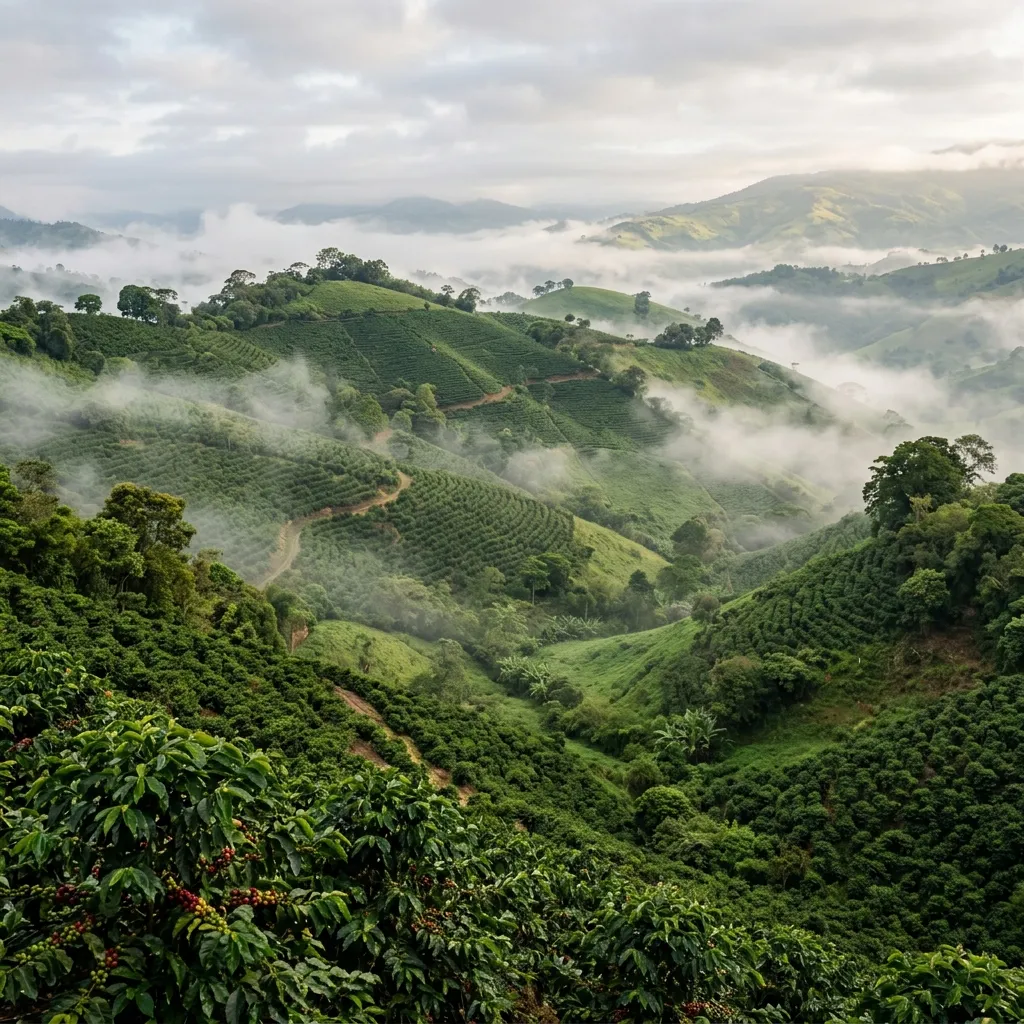
The more interesting story is climatic. Southern Ecuador sits in a transition zone where the Andes become less of a continuous wall and more of a complex system of ridges, valleys, slopes and elevations. Moisture moving from the east interacts with Andean relief, while Pacific influences, local dry corridors and the geography of southern Ecuador add another layer of variability.
For coffee, that means terroir changes quickly. A farm at 1,700 meters on one slope can experience a very different combination of temperature, humidity, radiation and rainfall from another farm at a similar elevation only a few kilometres away. Research conducted in Loja confirms that even coffee agroforestry systems within the province can substantially modify temperature and relative humidity compared with exposed areas.
This is one reason why microclimate matters more than a single provincial average.
Two Air Masses, One Province
It is tempting to describe Loja as simply the place where the Andes meet the Amazon. Geographically, the reality is more complex.
Loja lies between the humid Amazon Basin to the east and the drier Pacific-facing environments and Sechura influence to the west. Its climate is shaped by elevation, mountain orientation, trade winds, the Intertropical Convergence Zone and Pacific–atmosphere interactions. Existing origin studies for Lojano coffee consequently divide the province into several climatic and geographic production corridors rather than treating Loja as a single uniform environment.
That distinction matters for specialty coffee. Moisture arriving from the east does not simply “rain on Loja.” Mountains intercept and redirect airflow. Valleys create pockets of warmer or cooler air. Slope orientation changes solar exposure. Forest and shade modify humidity and wind. Elevation changes the thermal regime.
The result is a gradient rather than a single climate. Published data for the province illustrate the scale of that variation. Depending on the production corridor, documented coffee-growing areas span roughly 200 to more than 3,000 meters above sea level, while average temperatures reported for the cantons range from approximately 16°C to 26°C and annual precipitation from about 500 mm to more than 1,600 mm.
That is an enormous climatic range for one coffee-producing province.
Altitude and Slow Ripening
Altitude matters because altitude changes temperature. But the useful question for coffee buyers is not simply, “How high is the farm?”
It is: What thermal environment does the coffee experience while the cherries are developing?
Cooler conditions can slow the progression of fruit maturation. That gives the plant more time to develop and redistribute compounds associated with bean composition and sensory quality. Research on Arabica has found relationships between altitude, sucrose and acidity, although the magnitude of those relationships depends on shade and post-harvest processing rather than altitude acting alone.
This is important because “high altitude = better coffee” is too simplistic.
Altitude is a proxy for a broader environmental system. At a higher site, the combination of cooler temperatures, solar exposure, slope, soil, shade and water availability can create a longer maturation window. The effect may be expressed in the cup as brighter acidity, more defined sweetness or greater aromatic separation—but these outcomes are not guaranteed by altitude alone.
Loja’s own coffee geography demonstrates this variability. The official specification for Lojano coffee identifies distinct production corridors precisely because altitude, humidity, temperature and rainfall vary considerably across the province.
For a buyer, 1,800 meters is useful information. A temperature profile is better information.
Cloud Cover and Moisture
Rainfall is only one part of the water story. A coffee farm can receive a similar annual precipitation total to another farm and still experience a different growing environment because the timing of rainfall, humidity, cloud cover, wind and canopy structure are different.
This is particularly relevant in Loja, where mountainous terrain creates distinct moisture regimes.
A recent study of coffee agroforestry systems in three Loja production zones—Chaguarpamba–Olmedo, Puyango and Quilanga–Espíndola—measured temperature, relative humidity, wind and canopy cover over an extended monitoring period. Researchers found temperature differences of approximately −4.23°C to +2.23°C and relative-humidity differences of up to 10.54 percentage points between shaded agroforestry systems and more exposed conditions.
That finding changes how we should think about microclimate. The climate of a coffee farm is not simply the climate reported by the nearest weather station.
The farm itself creates part of its climate. Canopy density, tree species, slope position and surrounding vegetation influence radiation, wind and humidity. In Loja’s coffee systems, shade has been shown to materially alter these variables.
For coffee, this can affect flowering, cherry maturation, plant stress and the pace at which harvest becomes ready.
Night Temperatures and Sugar Development
Cool nights deserve particular attention. During fruit development, temperature affects the rate of physiological processes involved in maturation. Climate and altitude influence the maturation rate of Arabica cherries, while the accumulation of sucrose and other compounds in the developing seed is part of the biological foundation of coffee quality.
This is why producers and buyers often associate cooler high-elevation sites with longer maturation and more pronounced sweetness or acidity.
But there is an important distinction between a useful hypothesis and a verified farm-level measurement.
The often-cited 8–12°C nighttime range should not be presented as a universal Loja coffee statistic. Provincial sources document broad temperature variation, and some high-elevation locations can experience much cooler conditions, but farm-specific night temperatures need to be measured rather than inferred from altitude alone.
For serious traceability, the stronger statement is:
Night temperature is a farm-level variable worth recording because it helps explain the thermal environment in which cherry maturation occurs.
That is more useful than assigning the same temperature range to every coffee farm in Loja.
The Cup, Microclimate by Microclimate
There is no single “Loja flavor.” A better model is to think of Loja as a collection of climatic environments that can push coffees in different sensory directions.
The following framework is a working terroir model, not a deterministic flavor map. Variety, soil, shade, nutrition, harvest selection and processing can reinforce or override climatic effects.
| Climate expression | Typical environmental signal | Potential cup tendency |
|---|---|---|
| Cool, high-elevation sites | Lower mean temperatures, slow maturation, strong diurnal variation | Brighter acidity, floral character, greater definition |
| Cool sites with substantial cloud/shade | Reduced radiation, moderated temperature, higher humidity | Softer acidity, layered sweetness, delicate aromatics |
| Intermediate Andean valleys | Moderate temperatures, seasonal rainfall, mixed exposure | Balance between sweetness, acidity and body |
| Warmer, drier southern valleys | Higher temperatures, lower rainfall, stronger solar exposure | Fuller sweetness, dried-fruit or chocolate tendencies, often faster maturation |
| Moist mountain environments | Higher humidity, cloud influence, more persistent moisture | High aromatic potential, but greater drying and processing sensitivity |
The official Lojano coffee specification reaches a similar conclusion at the geographic level, dividing the province into four production corridors with distinct climatic conditions and associated sensory characteristics. It describes Lojano coffees broadly as having sweetness, fruit and floral expression, citric acidity, medium body and a clean aftertaste, while recognizing differences among the climatic corridors.
The key insight is therefore not that one Loja microclimate produces a particular flavor.
It is that the province contains enough climatic variation to produce multiple expressions under the same broad origin name.
That is an advantage for specialty coffee.
Why Two Farms Can Cup Differently
Imagine two farms at approximately the same elevation. One sits on a steep slope exposed to early morning sun, with relatively open canopy and dry air moving through the farm.
The other is surrounded by taller vegetation, receives more afternoon cloud, retains more humidity and experiences less direct radiation.
Their altitude may look almost identical on a spreadsheet. Their coffee does not necessarily have to.
The second farm may mature under a more moderated thermal environment. The first may experience greater solar exposure and faster drying conditions. Their harvest calendars can differ. Their optimal harvest window can differ. Their post-harvest requirements can differ.
This is why altitude alone is a poor definition of terroir. The more useful model combines:
Elevation + temperature + diurnal range + rainfall + humidity + radiation + slope + shade + harvest timing.
And, increasingly, that model can be supported by actual farm data rather than regional averages.
Reading a Farm’s Climate Data
For buyers evaluating a Loja lot, a farm-level climate sheet can be more revealing than a generic origin description.
At minimum, ask for:
| Variable | Why it matters |
|---|---|
| Elevation | Establishes the broad thermal and ecological context |
| Average temperature | Helps interpret maturation conditions |
| Minimum and maximum temperature | Reveals the real thermal range |
| Nighttime temperature | Useful for understanding the cooler phase of fruit development |
| Annual rainfall | Establishes overall water availability |
| Monthly rainfall | Shows whether moisture is concentrated or distributed |
| Relative humidity | Helps explain plant water relations and post-harvest conditions |
| Slope and aspect | Determines radiation and exposure |
| Shade / canopy cover | Modifies temperature, humidity and solar load |
| Harvest dates | Converts climate data into an observable production response |
The strongest data set is not necessarily the longest one. It is the one that connects climate → harvest → processing → cup.
For example:
Farm elevation: 1,720 m Mean temperature: 18°C Night minimum: 11°C Annual rainfall: 1,200 mm Harvest window: June–August Process: Washed Cupping result: 87.5 points Dominant attributes: citrus, florals, panela
That begins to tell a terroir story. And it can be compared from one crop year to the next.
Loja’s Climate is a Gradient, Not a Label
The most useful way to understand Loja coffee is to stop treating the province as a single high-altitude origin.
Loja is a climatic gradient. The Andes create altitude and complex topography. Moisture and airflow interact with that topography. Pacific and eastern influences contribute to regional differences. Local vegetation then modifies the environment at farm level. Research in Loja has demonstrated that these agroforestry systems can alter temperature and humidity significantly within the coffee-growing environment itself.
That complexity helps explain why Loja can produce coffees with very different sensory identities while still sharing the same geographic origin.
For the specialty coffee trade, this is more than an interesting geographic detail.
It is a sourcing opportunity. A buyer who knows only the country and province knows the origin.
A buyer who knows the farm’s climate begins to understand the coffee.
And a buyer who can connect that climate data to harvest timing, variety, processing and sensory results can begin to understand why that particular lot tastes the way it does.
That is where Loja’s real terroir story begins.
Explore More of Loja’s Terroir
Continue with our guide to the region: Loja Coffee: The Southern Ecuador Origin Shaping a New Generation of Specialty Coffee.
For a deeper look at the geological side of terroir, read Volcanic Soil and Coffee: How Mineral Landscapes Influence the Cup.
A Note on Farm-Level Data
Regional climate statistics are useful for understanding Loja’s geography, but they should not be substituted for measurements from an individual farm. Temperature, rainfall, humidity and shade can vary substantially within the same production corridor. For that reason, farm-specific climate claims should ideally be supported by weather-station records, calibrated data loggers or another clearly documented measurement source. The recent Loja agroforestry study demonstrates why this distinction matters: microclimatic conditions can differ materially even within coffee production areas.